Showing posts with label Age: Industrial. Show all posts

Wednesday, April 23, 2008

Caporetto: The battle that changed Italy

The dawn of October 24th, 1917, started with huge explosion sounds. A bombardment by the Austro-Hungarian artillery in the Caporetto area (Kobarid in Slovenian) starts the 12th Battle of Isonzo. The attack, lead by German special troops -"Sturmtruppen"- , quickly breaks the front and threatens to isolate the 3rd Italian Army defending it, forcing the enemy to withdraw in total disarray. The fleeing troops are overwhelmed with panic and they cannot hold a proper resistance anymore. Only at the Piave River, 100 km away from the place where the offensive started, and the last defense line before Venice, the front is finally established after the Germans and Austro-Hungarians have stretched their supply lines for too long. In only 15 days, German and Austro-Hungarian armies achieve one of the greatest victories in the war, causing more than 30,000 casualties to the Italians, and making 275,000 prisoners.

During the battle, a young German captain, Erwin Rommel, stands out when leading a 250 men company to the Mount Matajur, capturing more than 9,000 prisoners and thus receiving the greatest German medal, Pour le Mérite.

A demoralized army

The day before the battle, the Italian soldiers formed a tired, demoralized army. Since May 1915, Italy had launched up to eleven offensives at the Isonzo River (Soča in Slovenian), with minimal territorial gains at a terrible cost (around half of the 600,000 Italians fallen in combat during the Great War died at the Isonzo). The area is particularly easy to defend, because of its high cliffs and passes behind a wide water flow which usually floods.
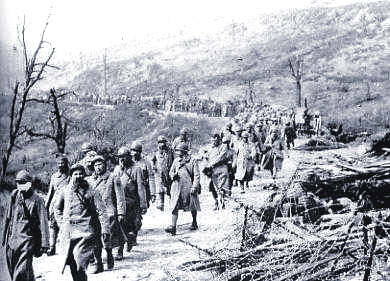
Despite all that, the Italian High Command chose this place to launch their attacks, mainly because it offered the best chances for territorial expansion. The great losses, together with the harsh discipline imposed by the officers, the long duration of this endless war, and the unpopularity of an offensive war, made an antiwar national feeling arise in the country.

A victorious army

The Russian Revolution in February 1917, and the decision of the Russian provisional Government to continue the war with a catastrophic offensive during the summer eventually brought down the Russian army's ability to continue fighting. After that, mutinies, mass desertions and surrendering of whole units with no resistance become normal. In this context, Germany and Austria-Hungary decide moving a large amount of units to the Italian front for the great offensive.

Besides, Germans came from the Eastern front with new efficient combat techniques, called infiltration tactics. Conceived by general Oskar von Hutier to break the stalemate caused by the trench war, they pursued surprise and quickness in the attack. They started with brief, intense bombings, followed by an attack lead by "sturmtruppen", supported by aircraft, with the aim of trespassing and disorganizing the rearguard, suppressing artillery support and communication lines. Then, the bulk of the infantry forces would clean the remaining pockets of resistance. These tactics had been successfully tested in September ending the siege of Riga, but they were used in large scale for the first time in Caporetto.

After their success, they were further used in the Western front, where the Germans almost reached the total victory at the Ludendorff Offensive. These tactics eventually settled the base of the German doctrine developed during the inter-war period, resulting in the principles of the Blitzkrieg, the tactics that kept Nazi Germany undefeated during the first half of the Second World War.

Italy reacts

The first consequences of the battle of Caporetto in Italy were the replacement of field marshal Luiggi Cadorna by Armando Diaz as the army chief commander, and also the formation of a new Government, somehow unavoidable after the continues quarrels between the defenders of neutrality and those for intervention.

However, the most influent change during the following years was the transformation of public opinion about the war. Before that, the army had fought in foreign territory with the aim of obtaining territorial acquisitions. Caporetto, on the contrary, was almost completely fought inside Italian land, switching the war objective to a matter of patriotic defense. This fact, together with the extent of the Italian defeat were skilfully exploited by some public figures, such as nationalist poet Gabrielle d'Annunzio, precursor of ideals and techniques in Italian fascism, and specially Benito Mussolini, then editor in chief of Il Popolo d'Italia. They called for patriotic feelings, discipline and fight against invaders and managed to rise the spirits of more than half a million new recruits, who contributed with the necessary strength to hold Austro-Hungarian attacks at the Piave and save Italy from occupation.

One year later, taking advantage of the high visibility and leadership he had managed to reach, Mussolini founded the Fascist movement, starting the darkest stage of Italian modern History.

Thursday, April 10, 2008

Artistic geniuses of Austria-Hungary

Vienna, at the dawn of the 20th Century, was a huge city, capital of the Austro-Hungarian Empire, and the fourth World political and financial centre. It is the classical era of Franz Joseph and Sissi, valses and operas, and viennois luxurious palaces and eclectic buildings. However, near the antiquated atmosphere led by the decadent Habsburg aristocracy and the close-minded artistic rationalism, there was an avant-garde hive of artists in the shadows, bursting with intellectual and sensual energy. This "clandestine" generation's works, progressist and provocative, constantly clashed with the conservatism in Austro-Hungarian culture. Nowadays, our modern point of view considers this one of History's most creative movements.

Symbolism vs Realism

During the last years of the previous century, the influence of symbolist trend arrived in Austria. This style had arisen as opposition to the prevailing realism and naturalism, which had stopped making sense after the spreading of photography. Symbolism rejected the mere representation of apparency in favor of ideas, a neo-romantic, spiritual new way of thinking. Thoughts are depicted about life and death, love, divinity, nature, the seasons of the year, etc. Specially the woman's figure is generally painted, itself symbolizing both desire and death (Klimt), a sensual being that becomes nearly magic (Mucha) and finally, simply provoking (Schiele).

Surrounded by this atmosphere between academism and symbolism, by old and new generations of artists from the Vienna School of Arts and Crafts, the young Gustav Klimt, son of a Bohemian immigrant, made his studies. He grew up in a poor, but close to art, family, and became an admirer of classicist painter Hans Makart. However, his experiments with allegoric motifs and his golden works in architectural decoration shaped his personal style, together with the search of the symbology transmitted by feminine sensuality.

In fact, he had trouble with the latter, when he performed the paintings called Philosophy, Medicine and Jurisprudence for the University of Vienna in 1894. The conservative personalities in politics, arts and religion from the Empire were scandalized by the explicit sexual language in these works, openly considered as "pornographic". Klimt never accepted assignments from public institutions anymore.

The secession of Vienna

Meanwhile, in France and Britain, Art Nouveau appeared. Directly related with symbolism, but much more focused on aesthetics than concepts, one of its greatest representatives was the Czech painter and designer Alfons Mucha, born in Moravia. After his failure in Vienna, he moved to Paris, where he achieved great prestige and an unexpected commercial success, specially designing the posters for actress Sarah Bernhardt and in symbolist magazines (La plume, 1898). Even without being related to Klimt, he also pursued spirituality through sensually depicting the feminine body, while treating woman as an untouchable character from a fairy tale.

The Austrian version for this kind of arts was represented by the movement of the Secession of Vienna, founded by Klimt and other artists in 1897, as a copy of those in Munich and Berlin. Years later, this would eventually have more influence than the latter in Art Nouveau trends. The aim for this institution was opposing the insipid prevailing eclecticism and encourage experimentation in new materials and decorative forms that, again, broke the classic trends of that time. In fact, they built their own exhibition pavilion, designed by one of its members, architect Joseph Maria Olbrich. Other artists in the institution were architects Otto Wagner and Joseph Hoffman, and painter Koloman Moser.

For five years, the company effectively created a new style, seceded from anything else existing at that time, by using purer, more abstract shapes and motifs in their works. Besides, they managed to mix different decorative arts in a single one -architecture, painting, metal work, decoration- nearly reaching the pursued idea of "total work of art".

In 1903, three of the main artists of the movement, Klimt, Hoffman and Moser, could not coexist with a faction opposed to the fusion of decorative arts anymore -the so-called naturalists-, and founded the independent Wiener Werkstätte. This institution eventually created the most truly distinctive style of Art Nouveau, by applying beauty to practical objects, characterized by simple shapes, minimalist decoration and use of geometric patterns.

Some years before, in 1899, in his Nuda Verita, Klimt had introduced a quote from Schiller: "If you cannot please everybody with your facts and arts, then just please a few". In effect, the arts produced at the Werkstätte defended the value of being manual and unique, in opposition to industrialist tendencies from schools of Arts and Crafts all along Europe, progressively more oriented to mass production. This elitist spirit was confirmed by Hoffman, when quoting that "as it is not possible to work for all the market anymore, then let us concentrate in those that can afford it".

Clashing with the surrounding social trends had a price: Both Hoffman and Olbricht were banished, the first to Brussels, the latter to Darmstadt (Germany), where he continued taking an active part in the city's modernist school. Meanwhile, Hoffman went on pursuing the practical application of arts into everyday objects, eventually creating the bases for the future Art Deco.

New secessions. Expressionism

Together with his disciple, Egon Schiele, Klimt created the Vienna Kunsthalle (Arts Hall) in 1917, in order to attract local artists and prevent them from fleeing abroad. Klimt became very interested in the young painter, introduced him to the Wiener Werkstätte, and in 1908 he got his first exhibition. Together they experimented with new symbolist trends, more focused on dreams and darker aspects of human conscience, such as anger and loneliness. Schiele's style, however, got increasingly different from his master's, as he overlooked the aesthetics of his works in order to concentrate in the pure expression of the idea. Expressionism had arrived.

We should not forget, with more a personal style, the genial, eccentric Hungarian painter Csontváry, also in the middle between symbolism and expressionism, and his mysterious paintings full of metaphors and dramatic sentiments.

Schiele abandoned Klimt to completely focus on the new style. Same as his master, Schiele gained great reputation all over Europe despite disliking traveling, in fact he preferred installing in his studio, far from the noises of Vienna. However, he did not cease to observe the neurotic behaviors of the population in the city, decadent and closed on itself, which were described by Sigmund Freud and depicted by Schiele and his contemporaneous Oskar Kokoschka, also disciple of genial Klimt. The latter became, after the premature deaths of the master and Schiele in 1918, arguably the most intense expressionist painter during the 20th Century, whose works, declared "depraved" by the Nazis and persecuted, showed the darkest, most heart-rending aspects of the hard period he lived.

Tuesday, March 11, 2008

Science and technology in Nazi Germany

That should be admitted. Germany during the years 1932 to 1945 became une of the main World centres, maybe even the main one, in scientific and technologic research. During that period, the bright German engineers created more than 300,000 patents, which, after the war, were appropiated by the Allies, who took advantage from them in further developments, that lead to many products we use nowadays.

This post is not at all a support or identification with National-socialist ideology or Hitler's regime. It just tries to show the technological advances achieved during this time and political context.

Military advances

Considering Hitler's military objective, there was a strong financial support to war oriented research. However, many of the achievements in weaponry were unused because of confrontations between different factions of the army, as well as Hitler's unstable planning abilities. Many resources were wasted in politically impressive but unrealistic projects, while little effort was made to make the new inventions practical. Despite all that, the Germans had technological advantages in the war, as they used inventions such as the first automatic rifle and the first railgun type guns.

The Messerschmitt Me 262 -called "Schwalbe", the swallow- was the first oprational jet plane in History. After a series of changes and failures, technically due to the lack of alloy able to resist the overheating due to high velocities, but also to Hitler's conviction in a quick victory and the unnecessarity of the new model, in May 1943 the prototype was ready. During the test flights, it reached nearly 900 kmph, what made Adolf Galland, chief of the Fighter Aviation, exclaim: "It looks like pushed by the angels!". However, Hitler's obsession for turning it into a bomber delayed its production in one year, and suppressing the great advantages it provided, speed and fire power against bombers. In the end, less than 300 units ever engaged in combat. Despite some punctual successes, such as the legendary actuation of the JV44 squadron, involving J. Steinhoff and Galland himself, which shot down more than one thousand planes, the jet fighter had no repercusion due to the general lack of fuel and expert pilots -it became a deadly trap for novices-. Besides, the confrontations of Göring with Galland caused it not to be built at the necessary scale. After the war, the Allies took possession of the remaining intact models, from which directly they developed the American F-86 Sabre and the Soviet MiG-15.

The U-boot, German submarines, were the most operative naval weapon they had during the whole war. Specially, the U-boot VII model was the most advanced model of the time, armed with five torpedo launchers while reaching 18 knots at surface. The tactics proposed by the Kriegsmarine commander Dönitz, the "wolf pack", was based in night group attacks to English convoys, which led to huge losses to the Royal Navy. Anyway, it took too long to the admiral to convince Hitler of the convenience of submarine war considerably decreased its scale. From 1943, the Allies learnt to face the U-boot by means of radar detection and torpedo launcher planes.

However, the major German innovation in submarine warfare was the U-boot XXI. This new-generation submarine, directly related to the design of the first American nuclear ones, combined novel technologies that could have made it into one of the greatest challenges for the Allied navy and decisively influence the war outcome. It included a new hydraulic reloading system, which granted a fire power six times larger than the VII type U-boot. On the other side, its sonar system allowed non-periscope-aided shooting, thus increasing its stealth. But mainly, the combination of its stylish hull design with the wide electric battery capacity, granted a higher speed when inmersed than on surface -17 knots vs 15- and a larger inmersion time, what made it specially difficult to hunt. From 1943 to 1945, 118 units were built. However, only two of them -U2511 and U3008- took part in combat missions before the end of the war, due to the large period needed to crew training in such a novel technology.

The first ballistic missile, the Vergeltungswaffe 2 ("Weapon of Revenge"), or V-2, was developed by a group of engineers led by Wernher von Braun in 1942, after a decade working on alcohol and liquid oxygen propulsion. But, even if it had all the support from Hitler, its mass production did not begin until the end of 1943. The rocket had its huge speed as an advantage, which made it virtually impossible to locate and destroy by the Allies. However, its short autonomy (little more than 300 km) and no precision, made it only useful for the indiscriminate bombings Hitler carried out in the English south coast. Until the beginning of 1945, almost 1500 rockets fell into British territory. Once the war was finished, both the USSR and the USA rushed to take the rocket specialists back to their countries. Among them, the team of Von Braun himself created the Saturn V rocket for the NASA, which -supposedly- took the man to the Moon in 1969.

V-1 should also be mentioned, developed in parallel to the V-2, and considered the first guided missile. Same as V-2, traditional defense measures used by the Allies -interceptor fighters, anti-aircraft guns, balloons, ...- proved uneffective for these new threats. The only adequate defenses were the destruction of launching bases and counterinformation activities (in which souble agent actions of the XX system, and specially the Spanish spy Juan Pujol, "Garbo", were of vital importance-.

It is also suspected that the Germans carried out nuclear tests in Thuringia in March 1945, two months earlier than the Americans. However, the classification of the documents that supposedly prove it has made it impossible to find out the degree of development they had.

Other inventions

In 1935, the engineer Fritz Pfleumer developed the K1, first magnetophonic recorder. This provided, the first concerts and political speeches in History were the German ones. Its military use was extensive, as a recording medium of both friend and intercepted transmissions. The Allies knew that the Nazis had such a device, but did not find it out until they invaded Germany in 1944. There, the American engineer Jack Mullin analyzed the device, a great invention for its time, which was commercialized by the firm Ampex and revolutionized the American media industry of the '40s and the '50s.

The first machine working with binary arithmetics, the Z3, including programming capacity, was developed in 1941 by the German engineer Konrad Zuse, and became in essence the first digital computer. Although it was destroyed in a bombing in 1944, it meant a step forward to the development, in 1948, of the famous American computer ENIAC, that added decimal arithmetics.

Infra-red devices were included in German interceptors that proved very usefil in night missions, while the Americans were starting to wonder if such a technology was possible.

In medicine, we will not point out the infamous pseudo-scientific experiments Dr Mengele carried out with concentration camp prisoners. From a more constructive side, German scientists of the time achieved the first direct relation of tobacco with lung cancer -and smoking was even banned in the Luftwaffe for several years-. They also were the inventors of methadone and modern pesticides.

Monday, February 11, 2008

The hell of Kursk

The battle of Kursk was not only the greatest armored confrontation in History, but also the turning point at World War II. From this point, Hitler's Germany ceased to hold the initiative in the East and passed to defend, which would not change during the rest of the war.

Barbarossa

The invasion of Russia -operation Barbarossa, started on 22th June 1941 and planned to be a rapid conquest, before winter arrived- had gone well for the Germans in the first months of campaign. Despite the too late beginning of the campaign -Russian winter would arrive anyway- and underestimating the defensive power of the Soviet Union, the German army was far more ready and had better logistic support. The surprise factor, air support and Soviet lack of organization allowed an advance of 50 daily kilometers. In August, the Wehrmacht was almost 100 km from Leningrad, Kiev and Smolensk. But an unexpected planning changement altered the course of the invasion.

Hitler had always believed himself a militar genius, and some strategic achievements during the war -largely, taking big risks- convinced him to personally take the command of the Eastern front troops. The initial plans of the campaign were, besides conquering Leningrad, to send the Southern Army sector to take control of the rich Caucasus oil wells, and the Central one to Smolensk and directly towards Moscow, which should be occupied before the winter. However, Hitler took a dicsoncerting decision, against the opinion of the whole High Command: he made stop the advance to the capital to reinforce the Southern Army, fighting harshly in Kiev.

Hitler had in mind that the Ukrainian city had to be taken, but due to the rugged resistance from the population, the siege finally lasted until October, slowering the whole progress towards the Caucasus oil fields. The result was that, upon the winter arrival, the important access to the oil had not been achieved. At the same time, the bulk of the Central sector, the 4th Wehrmacht Army, was at the gates of Moscow, but weakened because of this unexpected reinforcement, had wasted too long time in Smolensk, and also lacking of supplies, could advance no more.

From attackers to attacked

After the Soviet re-organization, the expulsion of the nazis from Moscow, and relative stabilization of the front during the winter, in 1942 the Germans finally tried to occupy the Caucasus. However, new conflicts between Hitler and the High Command made the Operation Blue to become a clumsy advance that eventually trapped the Germans in the battle of Stalingrad, where they lost their major elite force, the 6th Army.

Field marshal Von Manstein managed though to counteract the counteroffensive from Stalingrad, and even advancing on Kharkov during March 1943. He then proposed the High Command to tend a trap that, attracting the Red Army to the rests of the German 6th Army, would make an evolving movement that would envelop the Russians at the Donets Basin. Hitler, reluctant to envolving attacks, did not approve the plan and centered in Kursk, an area entering in the straight Russian front.

The objective was too obvious: the Russians predicted the attack, and the delay to July gave them further advantage -Hitler wanted the new Panther tanks to arrive to the front-. Generals Rokossovsky and Vatutin had set up tens of deffensive belts, and had progressive retreat plans while the Germans would be advancing. The Russians knew the offensive would come from the huge amount of tanks there accumulated. When they started Operation Citadel on 5th July, more than one million antitank mines decimated the armored columns. Russian artillery and air force, after two years of campaign, were comparable in number and readiness to the German ones, and destroyed the German artillery support.

Although Panzers were still a formidable weapon supported by the Luftwaffe, they lacked the proper infantry support, and Russian soldiers were able to easily destroy them with antitank guns or simple molotov cocktails. Besides, the new models -Tiger and Panther- were very scarce and did not whos the expected results. More than half were out of operation the first day because of problems with their cooling system.

On 12th July, the Germans believed to be near the end of the Russian defensive belts. However, when entering Prokhorovka, the SS-Panzerkorps found itself in front of a whole armored division of Soviet T-34. The greatest armored combat in History (400 German tanks against 900 Soviet ones) ended up as a technical draw, but was a huge moral defeat for the Nazis, who thought to be close to victory. On 17th July, when the Wehrmacht soldiers saw all the Panzers being retired and moved to the new Sicily front, they realised that they would pass to a defensive role. Soviet counterattacks started immediately. The attackers became attacked.

Tuesday, December 18, 2007

History of a kiss

One of the greatest kisses in History is the one that took place between communist leaders Erich Honecker, from East Germany, and Leonid Brezhnev, from Soviet Union, during the 30th Anniversary of the German Democratic Republic in June 1979. Despite the controversy and ridicule arisen in the West, this was actually a common sign of socialist solidarity, very used since Khrushchev era. It seems, moreover, that both leaders were very keen on kissing*. However, this kiss has a greater story.

The good kiss

Honecker had become the leader of German Socialist Party in 1971, after the fall of Walter Ulbricht in disgrace, thanks to Brezhnev support, and in 1976 had become president of the Counsel of State of the GDR, also aided by the latter.

In the new 70's spirit of the "détente", the Soviet Union achieved, in exchange of a relaxation of weapon tensions, that the United states recognised its influence area in Eastern Europe. In this political atmosphere appeared the "Brezhnev Doctrine", that imposed the right for Soviet military intervention in European socialist states. This happened, for instance, in the invasion of Prague by the Warsaw Pact in 1968, with the passivity of Western allies.

Honecker carried out a series of economic reforms in the GDR that lead the country to a so-called "consumption socialism", that resulted in an improvement of the population's standards of living. Apart from that, relationship with its Soviet colleague were a true love story. GDR and the USSR needed each other, the first became the greatest ideological defender of Communism in a time when this system was more than questioned. In turn, the Soviet Union guaranteed the Red Army intervention in case of a popular revolt similar to that in Prague, which was pretty probable considering the number of opponents to Honecker's regime. Finally, the GDR was interested in furthering all possibilities of German reunification, so the "détente" politics was very useful to follow.

Nowadays, a painted version of the "Fraternal Kiss" can be seen on the eastern side of Berlin Wall's ruins, performed by Dmitri Vrubel after the collapse. If one looks to it attentively, one can realise that this kiss is typical of a Greek tragedy, a suffocating kiss, in which lovers get too compromised on each other, despite of knowing that there is no future in that poisoned relationship. Actually, the painting is named "The Kiss of Death", and one can read under it "God, help me to survive this deadly love".

The bad kiss

Exactly, when Mikhail Gorbachev came to power, the romance was over. His only ambition was to save his country from economic ruin, after the disastrous conditions in which Brezhnev had left it. After presenting a series of reforms concerning restructuration (perestrokia) and openness (glasnost) he would carry out, Gorbachev announced the end of Brezhnev Doctrine: the Soviet Union had not the will to impose the political regime to any East European country anymore.

During Gorbachev's official visit to Eastern Germany, in October 1989, Honecker had the intention to ask the Soviet Union for a fundamental aid to keep order in the country, However, upon his arrival, the relationship had cooled down: the protocol kiss Gorbachev gave him was very different to that of ten years ago. This one actually meant "my friend, you are alone". Less than one year later, GDR had ceased to exist.


* A contemporaneous joke showed Brezhnev staring at the departing plane of a foreign leader, exclaiming: "As a politician, rubbish... but what a good kisser!".

Sunday, November 11, 2007

Millet or silver cookies

Amadou Hampâte Bâ tells in his book Mémoires that, in the French West Africa, the governor of Dakkar imposed a tax to the indigenous people in his territories, something ironically called "the price of the soul", because of being the tax to be paid for the right to life. It was through the circle commanders that taxes were collected.
"Silver cookies?"

One day in the year 1916, the governor had decided that, since then, the tax could not be paid in nature anymore, but in cash. The commander in the circle of Dori gathered the chiefs of tuareg tribes to let them know the new rule.

When the chief of Logomaten tribes was present, he told the interpreter: "Tell the chief that, by the governor's order, from now on the tax will not be collected in nature, but in currency."

The interpreter turned to the chief and expressed in the Fula language of Dori: "The commander has said that the great governor has said that from now on the tax must be paid in bouddi". It must be said that, in Fula, the word bouddi is used to designate coins of five francs, but also boiled millet cookies.

The tuareg chief, very happy, smiled and said: "Interpreter! Thank the commander, and tell him that I own a great amount of millet, and also servants that can prepare as many bouddi as he wants, enough to feed the population of Dori during months!".

The interpreter realised about the mistake: "He does not mean bouddi of millet flour, but bouddi in money." The chief, confused, asked to be shown a sample of the cookie he was demanded. The commander gave a five francs coin to the interpreter, who held it to the chief. He turned it, stared at it, weighed it, bite it... afterwards gave it back to the interpreter: "This silver cookie, where was it cooked?". After listening to the interpreter, the commander exploded: "In France! Where does he want it to come?".

"In France?", said the interpreter, surprised. "Interpreter, tell the commander to be reasonable. He is asking me to give him money cookies that have been cooked in France, being French himself. I am a tuareg from Dori, who can only make millet cookies. It should be me who asked him for money cookies from his home, and not the contrary! If the commander wants the tax to be paid in camels, oxes, lambs, goats, millet, rice, butter or slaves, then I can do it. But if he is demanding me to give him the cookies he is showing me, which are cooked in France, then he wants fight. I accept! But I warn him: the tuareg I am finds fight as one's element!".

Immediately after, he showed the right arm to the commander: "Interpreter! Tell the commander to look at my arm. It is not less white neither worse that his. Look at my nose: it is not less straight than his. I am as white as him. If we were alone, man to man, the commander would not dictate me his will, as he is not stronger neither braver than me. If he wanted, I would invite him for a personal duel at the dunes, and I would be sure to beat him. But no... the only advantage the commander has on me, which allows him to torment me with his "I want this" and "I do not want that", is because his country is stronger than mine."

Whitout saying farewell, the tuareg chief went out and jumped on his dromedary. There was never a duel between the commander and the chief, but a war between France and the tuaregs, specially the tribes of Logomaten and Oudalan. It was the great revolt of 1916.

Thursday, June 21, 2007

Two Germanies

A brief timeline of the process that meant the division of Germany after the Second World War.

12 - 16 September 1944: During the Quebec Conference, the Morgenthau Plan for the occupation of Germany is approved. This plan aimed to dismantle the whole German heavy industry and transform the country into two independent "agricultural States", in order to avoid future rearmaments. The Plan was finally rejected, but was a guide for the later process.

8th May 1945: Inconditional surrender of Germany, carried out by marshal Doenitz. 15 days later, the German General Staff is arrested.

5th June 1945: Establishment of the Allied Control Council, based in Berlin, for the government of the occupied Germany, with shared powers among USA, Soviet Union, United Kingdom and France.

End of May 1945: Brno Death March. 24000 Germans from the Sudetes are forced to walk towards the Austrian border, expelled from Checoslovaquia. Nearly 1000 die of violent treatment and disease.

17th July - 2nd August 1945: Potsdam Conference. Division of Germany and Berlin in 4 territories administered by USA, Soviet Union, United Kingdom and France. The Soviet Union unilaterally modifies the German border with Poland to the Oder-Neisse line. Forced expulsion of the German and mixed population from all the Eastern Europe countries is agreed. This will mean more than 14 million migrations during the next 4 years. According to the Morgenthau Plan, the reduction of the German heavy industry is agreed, as well as a control to its Foreign Trade. However, no agrement is reached about occupation, as the Soviet Union claims a single demilitarized state under its rule.

January 1946: Beginning of the "denazification" process.

5th March 1946: Benes Treaties are ratified, which state that all property belonging to German residents in the Sudetes and expelled from Checoslovaquia are expropiated by the State as war payments. Germany starts becoming a country without practically any resource to fee an excessive and poor population.

29th March 1946: First Desindustrialization Plan for Germany begins, which aims to reduce heavy industry to 50% of the pre-war levels. Steel and automobile production is stricted, and the one for drinks, domestic goods, timber and Coke is promoted.

March 1947: The "Truman Doctrine" is made public, that defends contention towards emerging Communism. The Cold War begins.

Winter 1946-1947: A specially harsh winter, the situation of German population becomes unsustainable due to lack of food and fuel. Infant mortality in the country is double than that of Western Europe.

12th July 1947: Marshall Plan is proposed. The Soviet Union rejects it and forces all the States in Eastern Europe to do so, as a first relevant distancing between Allied powers.

July 1947: American occupation in Germny is more and more impopular. USA decides to cancel the current occupation directive, and substitutes it by another that aims the re-industrialization of Germany. The president Truman wants to recover an economically strong ally in Europe, over which to develop the damaged continental economy, and avoid that the low standard of living in the country leads to a Communist coup. France prefers keeping the hard directive. The Soviet Union is frontally opposed to the change, and goes on with desindustrialization (in its case, movement of German industry to Russia) in its zone.

January 1948: USA extends the Marshall Plan to Germany, and promotes the currency reform by introducing the German Mark in its occupation zone in June.

March 1948: The Soviet Union retires from the Allied Control Council, as a response to the economical measures taken by Western powers in their zones. A Communist system starts to be installed in its occupation zone and Eastern Berlin.

24th June 1948: The Soviet Union imposes the terrestrial Blockade to the three Western zones of Berlin through its occupation zone, alleging that the guarantee of this communication had never been signed. General Clay proposes the advance of an armored column towards Berlin, with orders to open fire if attacked. The Truman government rejects the proposal as "too close to a war". It is agreed instead to supply the city with three air corridors (one managed by each Western ally) using civil and military aircraft.

4th April 1949: NATO is created as a pressure means to the Soviet Union.

11th May 1949: The Soviet Union ceases the Berlin Blockade, due to its ineffectiveness and international pressure. 65 Germans, Americans and British have died during the supply operations, specially difficult due to obstructions imposed by Soviets.

23rd may 1949: The government of the Federal Republic of Germany is established in the territories occupied by USA, France and United Kingdom, with capital in Bonn. Western Berlin remains under the status of American military occupation, although its residents are granted German citizenship.

7th October 1949: The USSR creates the Democratic Republic of Germany, with capital in Berlin. The country, not internationally recognised, remains under Sovietic occupation.

1952: Due to the flow of Eastern Germans towards the West, the USSR closes the borders and establishes controls.

May 1955: Eastern Germany's status is switched from occupied territory to Soviet Union allied.

14th May 1955: The Warsaw Pact is created. Eastern Germany joins it in 1960.

13th August 1961: Thousands of Eastern Germans still trespass daily the border through Berlin. The government of East Germany, under the approval of the Soviet Union, starts boulding the Berlin Wall in order to close this hole, alleging the needs to raise an "anti-fascist protection barrier".

July 1962: The "Death Strip" is created, a fully watched space close to the Wall by its Eastern part. House suburbs are pulled down in order to leave an open space that eases shooting from watch towers. Until its destruction in 1989, it is calculated that around 200 people died tryin to jump the Wall.

21st October 1969: Willy Brandt becomes chancellor of Federal Germany. Under his rule, the Ostpolitik is promoted as a process of rapprochement and diplomatic normalization between the two Germanies. At a long term, this will mean the international recognition of the existence of two independent sovereign States, and the inmobility of their borders (after the Moscow Treaty in 1970).

Saturday, January 27, 2007

The end of the samurai

In the 19th century, Japan was far from the economic and political power we know nowadays. The Tokugawa system, feudal in most aspects, was based on the strict class hierarchy originally established by Toyotomi Hideyoshi. The warrior-caste of samurai were at the top, followed by farmers, artisans, and traders.

The samurai, traditionally a warrior class that was at the service of a lord, had increased their political and social influence during the Tokugawa period, by becoming landowners, courtiers, bureaucrats, and administrators rather than warriors. However their aristocratic status still kept the same warrior meaning influenced by the teachings of Confucius and Mencius. They were an educated class, had a complex code of obligations towards their lord (usually a daimyo), and a formalized chivalry code (called "Bushido"). They had the legal right to wear weapons (they actually were the only granted that privilege) and to cut down any commoner who did not show proper respect, although to what extent this right was used is unknown.

As a consequence of the rigid structure that composed the social system, Japan was a backward country when compared to the overwhelming power of the European and American empires of the time. Like other subjugated Asian nations, the Japanese were forced to sign unequal treaties with Western powers, which granted them one-sided economical and legal advantages in Japan. The very inflexibility of the caste system, lacking all forms of economic dynamism and neglecting inflation effects, unleashed huge economic crisis and general empoverishment.

The Meiji Restoration

En 1867, an alliance of several of the most powerful daimyo (Satsuma and Kido) with the titular Emperor finally succeeded in the overthrow of the Tokugawa shogunate after the Boshin War, culminating in the Meiji Restoration. The power of the Emperor became increasingly stronger, and after a series of confrontations against his former allies, he gained all the lands under his own control. The result of this deep change in the political system was the establishment of a centralised power supported by a completely new oligarchy that undertook a series of reforms in the country.

The Emperor was convinced that Japan needed to become a World power by following the model of the Western empires. This way, the four-caste division of the society was abolished and freedom of social and occupational mobility was guaranteed. The education became compulsory, and the education system reformed after the French and German ones. Freedom of worship was also established, a constitution was edited and several forms of democratic participation of the citizens founded. Agrarian reforms and massive industrial development were succesfully undertaken, the concept of a market economy and the adoption of British and North American forms of free enterprise capitalism were welcomed by a country that soon showed its abundance of aggressive entrepreneurs. As a consequence, Japan emerged as the first Asian industrialised nation and one of the new great World powers.

What happened to the samurai?

All this logically meant the end for the samurai. As they received fixed revenues from the government, their upkeep was a tremendous financial limit for a nation in development (there were 1.9 million samurais at the time), so the Meiji government started a slow process to progressively abolish this social class. Most of their salaries were diminished or cancelled, and the ones that remained had to convert them into government bonds (which, of course, had no guarantee of being valid if the central government failed). A Western-like nobility classification was established among the remaining samurai and courtiers: prince, marquis, count, viscount, and baron were new conceded entitlements.

The reform of the military was the real end of the samurai privileges. In 1873, nation-wide conscription was established, and the right to bear arms was extended to every male in the nation. In this manner, the samurai lost their right to be the only armed force in favor of a modern, Western-like army. Moreover, their honorific right to wear a katana in public was eventually abolished along with the right to cut down commoners who paid them disrespect.

Although many samurai became wandering warriors and some riots arose (such as the major Satsuma rebellion, lead by the samurai Saigo Takamori), most samurai adapted easily to their new condition. Many found employment as policemen or in the government bureaucracy, which resembled an elite class in its own right. The samurai, being better educated than most of the population, became teachers, government officials or military officers. However, the ideal of samurai military spirit lived on in romanticised form and was often used as nationalistic propaganda during the 20th century.

Monday, January 22, 2007

The Army of Freedom

During the Pacific War, the so called "Army of Freedom" of the United States showed enormous racial prejudices among its soldiers, as a direct consequence of the segregationism in the American society. Black soldiers were denied basic services, given not enough or null ammonition in the battlefield, or were even murdered by white military.

In 1941, the army of general McArthur established its headquarters in Queensland (Australia), where more than 50,000 soldiers arrived. And also in Australia, while white soldiers were received in open arms, the laborist Government of John Curtin did not allow to entry (aprox.) 12,000 black soldiers, strictly following an ancient Australian law for the white conservation of the continent (The White Australia Policy). Thousands of soldiers had to stay in their boats for weeks until the pressures of the American Government convinced Curtin. However, black soldiers were confined in the degradated suburb in the South of Brisbane, at the other side of the river. They were not allowed to cross to the North suburb and neither to go in dance places such as Trocadero Dance, under very hard punishments.

Australian population, however, never rejected these exotic soldiers, but on the contrary. They had specially success with Australian girls, so much that in the end, white American soldiers felt envious (never did Australian soldiers, their eternal party fellows). The American Military Police, formed by white men, made use of their power by putting lot of pressure on black soldiers, blaming them on false crimes, applying specially severe punishments and murdering several persons.

In March 1942, fights between these two groups made black soldiers to be moved out of the city, and installed in the forest near Townsville, living in subhuman conditions. In November the same year, serious confrontations arose again in Brisbane between the remaining white American soldiers and the Australian ones, which shows what was the source of the problem. However, black soldiers were not better treated from them on, and no war report ever mentioned the very serious facts that had happened.