Showing posts with label Curiosities. Show all posts

Tuesday, December 18, 2007

History of a kiss

One of the greatest kisses in History is the one that took place between communist leaders Erich Honecker, from East Germany, and Leonid Brezhnev, from Soviet Union, during the 30th Anniversary of the German Democratic Republic in June 1979. Despite the controversy and ridicule arisen in the West, this was actually a common sign of socialist solidarity, very used since Khrushchev era. It seems, moreover, that both leaders were very keen on kissing*. However, this kiss has a greater story.

The good kiss

Honecker had become the leader of German Socialist Party in 1971, after the fall of Walter Ulbricht in disgrace, thanks to Brezhnev support, and in 1976 had become president of the Counsel of State of the GDR, also aided by the latter.

In the new 70's spirit of the "détente", the Soviet Union achieved, in exchange of a relaxation of weapon tensions, that the United states recognised its influence area in Eastern Europe. In this political atmosphere appeared the "Brezhnev Doctrine", that imposed the right for Soviet military intervention in European socialist states. This happened, for instance, in the invasion of Prague by the Warsaw Pact in 1968, with the passivity of Western allies.

Honecker carried out a series of economic reforms in the GDR that lead the country to a so-called "consumption socialism", that resulted in an improvement of the population's standards of living. Apart from that, relationship with its Soviet colleague were a true love story. GDR and the USSR needed each other, the first became the greatest ideological defender of Communism in a time when this system was more than questioned. In turn, the Soviet Union guaranteed the Red Army intervention in case of a popular revolt similar to that in Prague, which was pretty probable considering the number of opponents to Honecker's regime. Finally, the GDR was interested in furthering all possibilities of German reunification, so the "détente" politics was very useful to follow.

Nowadays, a painted version of the "Fraternal Kiss" can be seen on the eastern side of Berlin Wall's ruins, performed by Dmitri Vrubel after the collapse. If one looks to it attentively, one can realise that this kiss is typical of a Greek tragedy, a suffocating kiss, in which lovers get too compromised on each other, despite of knowing that there is no future in that poisoned relationship. Actually, the painting is named "The Kiss of Death", and one can read under it "God, help me to survive this deadly love".

The bad kiss

Exactly, when Mikhail Gorbachev came to power, the romance was over. His only ambition was to save his country from economic ruin, after the disastrous conditions in which Brezhnev had left it. After presenting a series of reforms concerning restructuration (perestrokia) and openness (glasnost) he would carry out, Gorbachev announced the end of Brezhnev Doctrine: the Soviet Union had not the will to impose the political regime to any East European country anymore.

During Gorbachev's official visit to Eastern Germany, in October 1989, Honecker had the intention to ask the Soviet Union for a fundamental aid to keep order in the country, However, upon his arrival, the relationship had cooled down: the protocol kiss Gorbachev gave him was very different to that of ten years ago. This one actually meant "my friend, you are alone". Less than one year later, GDR had ceased to exist.


* A contemporaneous joke showed Brezhnev staring at the departing plane of a foreign leader, exclaiming: "As a politician, rubbish... but what a good kisser!".

Sunday, November 11, 2007

Millet or silver cookies

Amadou Hampâte Bâ tells in his book Mémoires that, in the French West Africa, the governor of Dakkar imposed a tax to the indigenous people in his territories, something ironically called "the price of the soul", because of being the tax to be paid for the right to life. It was through the circle commanders that taxes were collected.
"Silver cookies?"

One day in the year 1916, the governor had decided that, since then, the tax could not be paid in nature anymore, but in cash. The commander in the circle of Dori gathered the chiefs of tuareg tribes to let them know the new rule.

When the chief of Logomaten tribes was present, he told the interpreter: "Tell the chief that, by the governor's order, from now on the tax will not be collected in nature, but in currency."

The interpreter turned to the chief and expressed in the Fula language of Dori: "The commander has said that the great governor has said that from now on the tax must be paid in bouddi". It must be said that, in Fula, the word bouddi is used to designate coins of five francs, but also boiled millet cookies.

The tuareg chief, very happy, smiled and said: "Interpreter! Thank the commander, and tell him that I own a great amount of millet, and also servants that can prepare as many bouddi as he wants, enough to feed the population of Dori during months!".

The interpreter realised about the mistake: "He does not mean bouddi of millet flour, but bouddi in money." The chief, confused, asked to be shown a sample of the cookie he was demanded. The commander gave a five francs coin to the interpreter, who held it to the chief. He turned it, stared at it, weighed it, bite it... afterwards gave it back to the interpreter: "This silver cookie, where was it cooked?". After listening to the interpreter, the commander exploded: "In France! Where does he want it to come?".

"In France?", said the interpreter, surprised. "Interpreter, tell the commander to be reasonable. He is asking me to give him money cookies that have been cooked in France, being French himself. I am a tuareg from Dori, who can only make millet cookies. It should be me who asked him for money cookies from his home, and not the contrary! If the commander wants the tax to be paid in camels, oxes, lambs, goats, millet, rice, butter or slaves, then I can do it. But if he is demanding me to give him the cookies he is showing me, which are cooked in France, then he wants fight. I accept! But I warn him: the tuareg I am finds fight as one's element!".

Immediately after, he showed the right arm to the commander: "Interpreter! Tell the commander to look at my arm. It is not less white neither worse that his. Look at my nose: it is not less straight than his. I am as white as him. If we were alone, man to man, the commander would not dictate me his will, as he is not stronger neither braver than me. If he wanted, I would invite him for a personal duel at the dunes, and I would be sure to beat him. But no... the only advantage the commander has on me, which allows him to torment me with his "I want this" and "I do not want that", is because his country is stronger than mine."

Whitout saying farewell, the tuareg chief went out and jumped on his dromedary. There was never a duel between the commander and the chief, but a war between France and the tuaregs, specially the tribes of Logomaten and Oudalan. It was the great revolt of 1916.

Friday, December 29, 2006

Christmas and its pagan symbols

Despite of its oficially religious meaning, the Christian celebration of Christmas comes from pagan rites almost totally. A recent study from Manuel Mandianes shows it.

The dates

From the IV century, Christians started to celebrate this new festivity (only Easter was celebrated until this date), and, from the V century, because of the progressive division between the Western and Eastern Roman Empires, it was also divided in two: Christmas, celebrated in the Western, and Epiphany in the Eastern.
The date of birth of Jesus is not known exactly. An old oriental myth tells that Mythreas, god that protects the cosmic order and human justice, and guaranteed peace treaties, came out from a rock a 25th of December, with the aim of liberate men from the Evil. Some shepherds attended his birth. Later on, under the influence of Babylon, the same god appears as an envoy of the Sun with the mission of creating life on Earth.
Christian tradition added the date of 25th December in order to move people far from pagan traditions of Natalis Solis Invicti in a period of decadent paganism, in which the Sun worship was very used. The Church placed the birth of Jesus in the moment of solar re-birth, in the winter solstice.
In 1582, the Gregorian calendar corrected the Julian one in some days, a change Orthodoxs refused to accept. That is why they celebrate their Epiphany the 7th January. Later on, maybe due to habits or to try to attract the Orthodox Church, the Catholic Church adopted the 6th January as the Epiphany, a festivity additional to Christmas (even if their significance is, theoretically, exactly the same).

Tree vs Nativity scene

The rivality between the Christmas tree and the nativity scene started in the XVI century, as a result of the fight between protestants and anti-reformists. The Church had been reoresenting the birth of the Messiah and the adoration of the Wise Men for centuries, while the first known Christmas tree is located in Alsatia, XV century, although they have very ancient pagan and druidic antecedents.
The Lutheran reform, in the XVI century, was against the scenes, trying to avoid any form of idolatry, and imposed the tree in Protestant countries. The tree, without the fact of idolatring figures, still had a religious symbology. The Caholic reaction was to modernise them; scenes progressively showed a more realistic representation of people and facts. They were soon full of non-religious figures, shepherds, that represented every kind of job and work.

Santa Claus

The current figure of Santa Claus is inspired in a Christian priest of Greek origin called Nicholas, who lived during the IV century in Anatolia and, while coming from a rich family, shared his belongings with the poors.
The transformation of Saint Nicholas in Santa Claus happened around 1624. Dutch immigrants in America took their habits and traditions with them, among them Sinterklaas, their saint patron. In 1809 the writer Washington Irving wrote a satire in which he changed the name of this Dutch saint according to the English prononciation: Santa Claus.
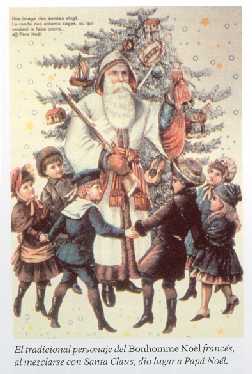
In the middle of the XIX century, the American figure of Santa Claus was exported to England, and later to France, where it was unified with Bonhomme Noel, a bearded character who dressed in white with bright decorations. From this union comes the current figure of Santa Claus, whose definitive appearance was designed in 1931 by Coca-Cola.
The habit of giving gifts to children in Christmas appears in the Ancient Era. Rome dedicated a festivity in December to Saturn (Chronos for the Greeks), in the end of which gifts were received by children. European children received them in later times, coming from very different characters, both religious (Wise Men in Spain) or pagans (the witch Befana in Italy).
Later on, Saint Nicholas replaced most of these characters. Since 1822, the Santa Claus visit is represented on Christmas Eve. Its adoption was very successful in the US because it satisfied a needs of the American society, as gifts were equally given to protestant, jewish, orthodox or lay children. Currently it is a pagan symbol accepted all around the world.

Wednesday, December 06, 2006

A noble eagle or a scavenger ugly bird?

After the American Independence War, the Continental Congress of the recently created United States decided it was imperative to create a set of symbols to represent the new nation. Among them, a committee was designated to ellaborate the design of the future American Great Seal, since used for representation of the coat of arms and the president, as well as other institutions. This committee was composed by three men: John Adams, Thomas Jefferson and Benjamin Franklin.
One of the hottest arguments between the two latter was about choosing a bird to be included in the symbol, so that it represented the spirit and the moral of the new nation. Jefferson proposed the bald eagle as such, an endemic bird in North America, with an arrogant, vigilant look. A bird with this appearance, he thought, cannot be but a noble and brave one.

A bird with not much of a noble behaviour

However, if we observe the citations made by biologists and naturalists about the behaviour of this bird, such as the works of Mark Catesby and Meriwether Lewis, we can realie that this bird is actually all except noble and brave.
The bald eagle is a carnivore, not a good hunter though. It nearly always feeds of carrion from dead animals or rests abandoned by an imperial eagle. When it eats fish, it usually gets close to the tracks of migration for salmons, and catches those dead on their way. Or it just waits patiently that an osprey, very skilful in catching fishes on the fly but smaller than the bald eagle, fetches a fish, and then steal its food. However, it never dares to fight an imperial eagle, while they are the same size.

Analogies

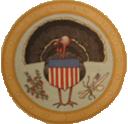
Benjamin Franklin never supported the bald eagle for the United States symbol. He said about it, in a letter to his daughter, that "it is a bird of bad moral character. He does not get his Living honestly. You may have seen him perched on some dead Tree near the River, where, too lazy to fish for himself, he watches the Labour of the Fishing Hawk; and when that diligent Bird has at length taken a Fish, and is bearing it to his Nest for the Support of his Mate and young Ones, the Bald Eagle pursues him and takes it from him." Franklin proposed the turkey as the symbol, a truly brave and arrogant bird according to him.
The 20th June 1784, the Congress supported Jefferson and approved the bald eagle as part of the Seal. Did Jefferson suspect what would the American relations be like towards politically weaker countries, and in the contrary, in situations in which it would compete with someone with its same size? The extermination wars against American natives, economic fagocitation of South America, predation with oil resources, sale of weapons to countries in civil war... and at the same time, negation of inconditional help to Europe during the Nazi invasion, the political game played with the Soviet Union (another bald eagle, but a bit more foolish), or the likely little heroic retreat from Irak... Actually, the bald eagle is perfect for this symbol. What a black humour, Jefferson.