Showing posts with label Age: General. Show all posts

Saturday, January 19, 2008

History of Writing

It is commonly said that the history of a civilization begins with the arrival of writing, as it is then allowed to have historical memories, communicate among population and ease the complex processes of administration and trade. Precursors of writing appeared in Prehistorical era as paintings and petroglyphs on wood and rock. Although they were used for religious rituals, some Neolithic petroglyphs were a communication tool, such as in Scandinavia, where they were used to delimit territories between tribes. Some supposedly cartographic and astronomic maps have benn found too.

Drawings, ideas and phonemes

A few millennia before Christ, the new needs of urban societies lead to the creation of writing systems more or less standardized. These systems appear independently in various places around the planet, but it is interesting to point out that all of them follow the logical evolution of human brain: starting with pictograms, or symbolic illustrations of objects as they are. These signs progressively move away from concretism and unicity typical of petroglyhps and derive in pure representations of concepts and ideas, called ideograms. Obviously, as they represent universal ideas, similar symbols are found in many non related ancient scripts -idea of man is the same everywhere, and symbols representing man do not differ much-.

Among the first logographic -i.e. composed by pictograms and ideograms- the most relevant ones are those developed in Middle East around fourth millennium before Christ. In Mesopotamia and Egypt, engraved clay tokens had always been used for accounting commercial products. This derived in Mesopotamia, around 3400 BC, to clay tablets on which numerals, and then pictograms, were engraved with triangular wedges. This is called as cuneiform script, where signs were drawings performed by complex combinations of notches. From 2900 BC, pictograms became increasingly simple and abstract, and eventually some lost their meaning and represented syllables of Sumerian language-what is called phonetic instead of logographic-. However, some writing systems as Hurrian and Hittite evolved from cuneiform in its purely logographic phase, that is why they have been very difficult, or impossible, to decipher by archaeologists. Progressively, from 6th century BC, cuneiform scripts were replaced by aramaic ones.

Egyptian writing system, dated from a similar time, was related with cuneiform, although commonly written on stone or plaster, and later on papyrus, with a more advanced and stylized technique. In Egype logogram systems are known since 3200 BS, from which appeared, one thousand years later, the famous hieroglyphs. These were systems composed by logograms, determinatives -that precised the contextual meaning- and phonemes, which were, effectively, the first alphabet in History, considering that alphabets use a sign for every sound or phoneme. Its use evolved to Meroitic, and expanded replacing logograms around Mesopotamia, where appeared during the last millennium before Christ, alphabets on cuneiform script, such as Ugaritic and Persian.

These writing systems were difficult to master, and during some centuries, only the elitist class of scribes had the knowledge to do it. All the literature in that period came out from different scribe schools, where people from high social classes entered at the service of temples or military authorities. In Mesopotamia, when cuneiform adapted to new dominant languages during Akkadian, Babylonian and Assyrian times, and in Egypt with the adoption of Demotic, writing was simplified and extended its use among most of the population, despite the efforts of scribes to keep their position by using cult and ancient scripts, Sumerian cuneiform and Egyptian hieroglyph, getting further from popular writing.

The Phoenician transcendence

Around the 11th century BC, an alphabetic form of hieroglyph, the hieratic, evolved. In Africa horn it became the Ge'ez or Ethiopic alphabet, and northwards it was adopted by Semitic language speakers to become the Phoenician alphabet, of abjad type -i.e. without specific phonemes for vowels-.


Later, together with Phoenician colonization, it turned into the main writing system in the Mediterranean, from which most current alphabets arose. In its Western variant, the Greeks adopted this alphabet and introduced vowels, from which Etruscan and Latin alphabets were directly developed. The latter only changed in format during the Middle Age -in the Carolingian Empire lower-case letters appeared-, and thanks to the spreading of Christianism and translation of the Bible, expanded around Occident. It had to compete in Eastern Europe, though, with Cyrillic, an evolution of Glagolitic, a variant of Greek established in the 9th Century by Saint Cyril. Cyrillic, invented in the 10th Century by Saint Clement of Ohrid, in Byzantium, was used in liturgies and the Bible all around the Orthodox Church territory -recently, in the 18th Century, Romania adopted back the Latin alphabet-.


In Egypt, Coptic appeared in the 1st Century BC as a transformation of ancient demotic on Greek alphabet and used by Christians in the country. Among Celtic and Germanic population, Ogham and Runic alphabets were spread and used before Christianization, sculpted on stone or wood, with ritual or magical aim. Other Greek derived alphabets appeared as practical solutions, to allow Bible translations adaptable to the phonetics of the language. In the 4th Century, the bishop Ulfilas created in Nicopolis the Gothic alphabet, that replaced Runic scripts and was used in Northern Europe for centuries. Armenian alphabet was invented in the beginning of the 5th century by Saint Mesrob with the same objective, similarly to the mysterious Georgian alphabet, supposedly related with Aramaic, too.

Eastern variant of Phoenician, the Aramaic, remained an abjad. From it, Hebrew directly arose in the 10th Century BC, and some centuries later, from a popular variation in lower-case letters, Arabic and Brahmi. Because of the expansion of Islam during the Middle Ages, Arabic became the official writing in the great muslim empires, from Al-Andalus to Persia. It progressively replaced other Aramaic alphabets, such as Orkhon and Sogdian in ancient Turkish territories, and Tifinagh, of Berber origin, currently used very seldom by Touaregs.

Aramaic writing arrived to India through Persian traders, and extended around the peninsula during the 3rd Century in the Asoka reign, who already used a form of Devanagari alphabet to write his edicts. Later, this family of alphabets sufferd many changes, in order to adapt the phonetics of Semitic languages to the different ones from India to Southeast of Asia -Devanagari, East Nagari, Oriya, Gujarati, Ranjana...-. Because of Buddhism, ancient Brahmi alphabet was used in practicing territories. Northwards, it derived towards Mongol, Tibetan and Phags-Pa alphabets. The latter, created at the time of Kublai Khan to adapt better to Chinese and Mongolian phonetics, eventually became a model for the king Sejong of Korea, in the 15th Century, to create a new alphabet that combined Brahmi syllabic blocks with ideograms and phonemes to replace the Chinese, not adecuate to Korean phonetics. After centuries of harsh resistance from Aristocratic classes and Confucian adepts, Hangul alphabet became official with the arrival of Korean nationalism later in the 19th Century.


Writings of the East

With a completely independent origin, Chinese calligraphy appeared. It is certainly known that around 1500 BS, during the Shang dynasty, a writing system already existed, although recent findings in central China discovered signs similar to modern Chinese in sculptures dated from the ninth millennium before Christ, which can become the World most ancient scripts. Chinese language, originally, was formed by monosyllabic words, so that every character could only define a concept -ideograms-. Currently, it is the only writing not based on a phonetical alphabet, although many of its characters show pronunciation indications. At the diversity of existing Chinese languages, during the Qin dynasty the same script was formalized for all of them, still in use nowadays.

In the 4th Century, Chinese arrived to Japan, but Chinese calligraphy was not used to write Japanese, used by illiterate, until the invention of man'yogana. This syllabic block based script, originally used to write poetry, gave phonetic value, instead of semantic, to Chinese characters, making it apt to the language. From man'yogana, current hiragana and katakana come. Ideograms or kanji are copies from Chinese, used in the beginning to define new concepts coming from China. In the Meiji era, efforts were driven to simplify the language and introduce Latin characters in imported words.

Forgotten signs

Of course, the success of these writing systems lead to the disappearance of other ones, appeared in parallel thousands of years ago, but replaced by these because of being less adecuate to language or sociopolitical reasons. Some examples are Harappan script in the Indus valley, not deciphered yet, or the Minoic-Mycenic linear system, disappeared upon the arrival of Greek alphabet.

The huge diffusion of Latin writing all around the World, after the colonization and use in Europe of better supports for it, especially paper and printing, lead to its adoption by most languages. This happened in places where there was no writing method, and also in others where some primitive sign systems existed, generally ideographic. They all were eventually displaced and disappeared. In precolonial America the most developed was Maya system, sculpted on stone or painted on ceramics, of laborious ideograms, lost after the fall of the culture. It is also believed that Incas had one, made from knotted streams, as these formed a symbol system with repetitions, not deciphered yet though. In Africa there also were indigenous writing systems, such as Nsibidi system used by the secret society of Efiks, who governed Nigeria.

Sunday, December 30, 2007

Women of Africa

In Sub-saharan Africa, women have always had an important role. Despite being, in general, a traditionally patriarchal society, an institutionalised part of power, that limited the king, was hold by a woman of his kin (mother, sister, aunt or cousin). The queen consort often had decision power at the same level as the king in most of the affairs, as happened in the Mali empire. Moreover, it was not rare that a woman became queen, even when there were male successors to the throne. It was characteristic that women participate in wars. In the Ashanti and Dahomey there was a corps of women that accompanied the king to military expeditions.

Anna Nzinga (1582-1663), queen of Matamba-Ndongo, dominated the history of current Angola during thirty years until her death at 82 years old, and opposed a fierce resistance to the Portuguese, who eventually respected the borders of her kingdom. The Portuguese had found in Angola an unusually fertile territory, occupied by a population highly productive and trading in agricultural products, furs and diamonds. After fighting for a century they conquered the coastal part of the country, establishing an important exporting centre of diamonds and slaves in Luanda. Being sister of the king Mani Ngola, Nzinga was sent to negotiate with the viceroy Joao Correia Da Souza, and proved so skillful that passed from a defeat situation to the achievement that Portuguese removed their troops from Matamba. In 1624 she succeeded her brother as a queen, and faced Portuguese offensives without losing any territory, she reorganized the army, formed alliances with neighboring countries (and also with Netherlands) and constituted an efficient secret police.

Amina, queen of Zazzua (1533-1610) is known as a great warrior queen from Nigeria. Amina's mother, Bakwa of Turunka, was already queen of Zazzua, a Hausa state-city, title already hold by her grandfather. Amina was educated in government and warfare skills, and fought in battles together with her brother Karama, who became king at his mother's death. When he died in 1576, Amina succeeded him when she was 43 years old. She used her strategic skills to expand the territory of Zazzua to the mouth of the Niger, and towards Kano and Katsina northwards. These conquests lead to a stage of wealth to the kingdom, with the opening of new trade routes and the arrival of new tributes. Mud walls were risen in all the cities, still known nowadays as "Amina's walls". The queen refused to marry and had no children.

In the kingdom of Waalo, in Senegal, next to the French colony of Saint-Louis, the queen Ndete Yalla managed to maintain her territory in peace during ten years and imposed a tax to French settlers when they used transport in the Senegal river, and when it ceased to be respected, immediately ordered in 1855 the expulsion of all strangers, which meant war. In the current Ivory Coast, a woman, Pokou, took the leadership of her tribe, known as Baoulé, to save them from extermination, when the Ashanti confederation of Ghana, founded by her great-uncle, broke up, in a tragic exile that later became a legend.

Some queens were not exempt from cruelty. In Madagascar, the queen Ranavalona took the power when her husband, the king Radama, died (murdered by her orders, as it is believed). She ordered Christian missionaries in the island to be executed, decreed the expulsion of all strangers in 1857, and formed a kingdom of terror in which thousands of executions were carried out per year. It is also told that, in the territory of the Dschaks, in the inner Congo, once arised a queen who, after overthrowing her mother and killing her son, formed a female kingdom in which men were enslaved, sacrificed or assassinated. Pregnant women had to flee from the land until they gave birth, only if they brought back a little girl. The subsistence of her kingdom, lacking agricultural activity, was possible for several years with the sacking of neighboring people and villages, with who they did not cease to fight.

There were prophet women, too, such as Kahina, a berber priestess from Mauritania, who became the leader of her country's army and caused the first major defeat to Arabs in 690. Kimpa Vita in Congo, in the 17th Century created a religion that mixed Catholic and African concepts, which attracted the support of a great part of Congolese aristocracy to expel strangers from the country. She was accused of sorcery when she was 24 years old and burn alive together with her child.

Apart from politics, African women have had and still have an important role in economy. African women have always been excellent in domestic resources organization, because of the traditional complete lack of interest from husbands. This has allowed women to eventually create trade networks in order to focus these organizational skills and communication talents. Nowadays, 80% of autonomous business in sub-saharan Africa are carried by women, and there exist important women trade networks such as those in Accra (Ghana) and Nairobi (Kenya). Historically, it should be noted about the life of Tinubu, in the 19th Century, a Yoruba woman who started selling corn mush and later, with the support of a group of wholesale traders, created a business of slave traffic, that she abandoned when abolition spread and started trading palm oil. She eventually became the main mediator of Euro-African trade of the area, and thanks to her growing influence, became the main advisor of the king of Lagos. After being banished from the kingdom by the British, she acquired wealth with the arms trade and became a heroine of her home city Abeokuta in the resistance against the Europeans and the neighboring kings of Dahomey.

Sunday, October 21, 2007

Forced labours

All along History no government has ever ceased trying prisoners to generate wealth through forced labour. In fact, prisons have their origin in the accommodations for slaves, a compulsory labour force that existed since ancient times in Egypt, Assyria, Greece, Roma and Islamic caliphates. Slaves came from criminals, war prisoners and abandoned children, besides the slaves' children themselves.

In the Middle Age, the Carolingian Empire was supported by a 20% of slave population, but because of the Church's ban, this practice was abandoned between Christians. This relationship evolved from the 10th Century towards serfdom, in which the peasant was bounded to the land and the master. This system endured all around the World, with variations, from feudal lords in Europe to shogunates in Japan. In England it disappeared during the 17th Century and in France in 1789, but in Eastern Europe it remained until the mid-19th Century.

A modern serfdom form is the indenture, under which workers sign temporary contracts according to which they are only paid by accommodation and feeding. This labour practice was dominant in early colonial societies during the 17th and 18th Centuries, and is still common in developing countries, such as India and Bangladesh.

In 1452, the Pope Nicholas V issued the Bull "Dum Diversas", which allowed Christian kings to reduce Saracens, pagans and unbelievers to hereditary slavery. This fact started the massive traffic of black slaves, that remained until the abolition during the 19th Century. Thanks to the collaboration of most powerful African empires (Shongay, Benin), Europeans substituted Arabs as main African slave exporters. These slaves were mainly settled in American colonies, to work in large plantations. Even after the slavery abolition, southern states of the United States adopted the "Black Codes" that imposed forced labour and right to body punishment for blacks, remaining until 1866. Nowadays, slavery still exists in form of people traffic (specially women and children) kidnapped to practise sexual or labour slavery. There are currently more than 27 million slaves in the World.

Prisons and colonies

It is only with the appearance of the modern concept of punishment gradation that prisons are institutionalised. Before that, imprisonment was for political opponents, as common criminals were executed or sent to galleys (French king Louis XIV reduced death sentences so that he could build a well provisioned navy). With the capitalist and industrial economic development, and the consequent emigration to the cities, the authorities tried to convert the new masses of poor and unemployed in a profitable force, and buildings with penitentiary functions were made.

During the 18th Century, new humanist and utopic socialist ideas defined delinquent as a victim of the social order, and defended prisons as a means to correction with necessary long sentences, which lead to a massification of prisons. This way prisons were provided with complex vigilance systems, as these were supposed beneficial for the development of regret, same way that control over workers was an improvement in their work performance.

Because of the costly storage of so many prisoners, Britain was first to apply forced labour during the 19th Century (in mines or building of infrastructures), but not until 1853 was labour differentiated between different types of criminals depending on their crime seriousness. Colonial powers also encouraged criminals to join the army instead of being imprisoned (as Britain did during the Second World War). Or, in peace times, banishment to inhabited colonies was a frequent solution that, while colonizing new territories, moved undesirable people away from the metropolis.

Australia received 800 British prisoners as first habitants, in a date remembered today as National Day. Along the next decades, thousands of convicts moved to populate penitentiary and forced labour centres in the colonies. France created labour colonies in its South American possessions at French Guyana, infamous because of the brutal treatment to prisoners until their closure in the mid-20th Century.

Many colonies were initially conceived with production centres, during the 19th and 20th Centuries they were common in authoritarian governments that cruelly exploited the prisoners, as in Nazi Germany, Soviet Union, China, Romania and North Vietnam. Also victorious powers of the Second World War used Germans as compulsory labour force for reconstructions.

The first Nazi concentration camps were built in Germany to accommodate political opponents of the regime. Since 1942, camps were created close to factories in order to provide labour force. IG Farben established a synthetic rubber factory in Auschwitz III (Monowitz), and other camps were situated near plane and rocket factories, and coal mines. Prisoners were frequently sent in mass to the gas chambers when it was necessary to renew labour force.

Soviet Union created a huge network of Gulags (at least 476) to serve as a destination for the victims of Stalin purges. They were mainly ethnic minorities and, after the Second World War, Germans and even liberated soldiers of the Red Army. The most infamous of these camps were built in Siberia north of the Arctic Circle, in Kolyma, Norilsk and Vorkuta. In total, about 18 million people were in this type of camps, of which more than half died. Gulags were one of the pillars of Soviet industrial development, as they were assigned tasks of natural resource exploitation and infrastructure building in remote areas of the country.

A lucrative business

The United States have started to privatise imprisonment services (Wackenhut Corrections, Correctional Services Corporation and Corrections Corporation of America), adducing that the costs of private administration are much lower than public one. This kind of prison-companies offers convicts working for much lower incomes than common citizens, as the light cost of maintenance is included. As a consequence, prisons can make very advantageous contracts with big corporations, for tasks of product assembling.

Thursday, August 23, 2007

Holidays

Just arrived from holidays, it seems to me appropriate to tell why we have leisure days, who decided when they would happen, and since when we do tourism at the seaside or the mountain.

Origins of holidays

Originally, resting days were given by religious festivities or natural cycles. While the population was mostly rural, the main resting period (that coincided generally with the celebration of festivals) was after the harvest time, in a period varying from August to December.
The first journeys due to celebrations were pilgrimages to religious centres (Oracle in Delphi, Mecca, Temple of Mahabodhi, Way of St James, etc), or cultural events, such as the Olympic Games, and were made very few times a life. It was already common in these journeys to bring "souvenirs" back home. In the end of the Middle Age the first establishments known as "hotels" appear, created to accommodate important people who traveled with their entourage. Rich classes, moreover, used to have a villa or palace as alternative residence, often near the sea, where climate was mild. Some places were starting to stand out such as Baiae (Italy) during the Roman Republic.

Modern Age: English-like tourism

It is during the 16th Century that the interest of travelling and exploring new places. In England it becomes fashionable among the aristocracy to send the young men for a "Grand Tour" (from there came the word "tourist") during several years in order to complete their studies and have new experiences. At this time also baths are reborn (now as bath centres far from cities) and beaches, where first the English Royal Family moved (Weymouth, Brighton, etc.) and then spread among rich people, just for imitating. The renewed interest in topics such as Botanics, Archeology or Paleontology gave way to interest of hiking during the months in Spring and Summer.
The 19th Century witnesses the revolution in transports and the apparing of railway lines and transoceanic boats that make long journeys easy and cheap for the new burgeoisie, less elitist than ancient aristocracy, and also with time and money to spend. Health tourism is generalised, and beaches are joined by mountain: it is the time of mountaineering and sanatoria. The first entrepreneur iniciatives. mostly English, related to tourism appear: the first travel company "Cox & Kings" (1758), the first transoceanic company "Black Ball Line" (1818), the first organised trip by Thomas Cook (1841), the first travelers' cheques by "American Express" (1891) and the first comfort hotels by Cesar Ritz (1898).
It was also the English who, looking for a new leisure season, started Winter tourism in the Swiss villages of Zermatt and St Moritz in 1864, where the first ski resorts. This fact coincides (not by chance) with the invention of modern skiing by Sadre Norhein (1825) and his technique of "telemark".

Modern Tourism

Since the 1950s the "boom" of tourism in Western World takes place, thanks to political stability, elevation of standards of living, generalisation of cheap automobiles and urbanisation of society (that generates a new culture of leisure based in fleeing from stress of daily life). It is also then when tourism becomes massified: first the vehicle trip to the seaside, and then, when the reaction airplane appears, tourism packs to exotic destinations. During the 1960s all the aspects of tourism are legislated (insurances, rights of passengers, paid holidays).
Modern tourism dates from the 1980s, when it becomes diversified in many different types (cultural, rural, health, risk tourism), characterised by the liberalisation and internationalisation of the big tourism companies and the free exchange of people inside the European Union. Also recently appears the backpacker, a kind of independent tourist with few resources, and also low-cost flight companies. These are lately generating a new conception of tourism based on do-it-yurself and freedom, in a World where individuals have already enough education and power to do so.

Monday, March 12, 2007

Shadow plays

Shadow play is perhaps the most ancient scenic art in History. It is based in the projection of articulated puppets in front of an illuminated background, causing sensation of movement. During thousands of years, it has entertained and taught both humble and aristocratic classes, specially in Asia, where it was originated.

China: Poems and romances

According to the legend, Chinese shadow play dates back to the Han dynasty (3rd BC-3rd AD centuries), when an emperor lost his favorite concubine. A taoist monk used a shadow to evoke a feminine shape, which the Emperor believed was his reborn lover. What is certain, is that in the time of the Tang dinasty (7th-10th centuries), it was a popular entertainment very spread in the provinces of Shanxi, Shaanxi and Hebei, which later passed to Beijing. During the Ming period (XIV-XVII centuries) it was not exclusive of the lower classes anymore, and passed to the aristocracy and imperial family.

In China, puppets were small and made of paper or leather. A puppeter handled them with three sticks (one for the head, one for each arm), and made the voice of every character, while a small orchestra accompanied dramatic scenes (specially many "gongs"). There were four defined types of characters: men (sheng), women (dan), painted faces (jing) and clowns (chou), each of them with a specific symbolism and function.

Although this genre gave way to many regional styles, thematic was essentially the same: Buddhist teachings in the beginning, romances and epic lyrics later (the one referring to Liu Bang and Xian Yu was very popular, see previous post).

India: Mediator between men and gods

It is not known with certainty whether the shadow theatre appeared in India, Thailand and Indonesia originating from China or had an independent evolution. There are major differences, such as the puppet size (it was normally human in India, its size showing the character social rank though), and its lower articulating ability. Used matierals were coloured and translucent, leading to a much colour and surreal aspect.

This oniric effect has perhaps influenced its final significance. In the Indian region, shadow theatre was the main medium to express the supernatural, very used for the spreading of mythical Hinduist literature, the Ramayana and the Mahabharata. Performances even became rites with the powers of bringing rain and healing the sick and possessed.

In India, the puppeteer job was something hereditary, and almost sacred. Entire wandering families were in charge of building puppets and performing, being considered as some kind of priests. Nowadays, Indian shadow play is in decadence, except for the Wayang Kulit in Java, which enjoys an official protected status.

Turkey: Political satire

Maybe brought to Persia and Middle East by Gengis Khan's conquests, Turkish shadow theatre has Chinese influences. However, due to its colourful aspect, it is widely accepted that it comes from Ancient Egypt and Java, with influences from Greek phylosophy.

Featured characters evolve to the point of having a very defined symbolism, and the same appear in every performance. Most important are Karagoz and Hacivat (the first, showing his common sense, the latter his education), the courtesan Sitt al Husyn (who represents Love), and the doctor Mustapha (who symbolises power and corruption). The meaning was essentially satirical and didactical.

First described by Ibn Danyal in Cairo, during the 16th Century is spread in the Ottoman Empire. There it acquired great popularity, specially in Turkish cafes during the month of Ramadan and in Muslim feasts. However, it seldom had a religious significance, but instead it reflected social problems of the time, always from a humorous perspective. It was, say, the daily newspaper at that time.

Saturday, January 13, 2007

Domes

Dome is a particular type of vault, with a semispheric form, without angles or corners, which allows huge spaces in buildings, as well as the possibility of a powerful lighting. Despite they are thin, domes are the strongest architectural element, thanks to compressive and frictional forces the create.

Before domes, buildings were very space unefficient, as big columns were necessary to support the roof. Although the first examples of wooden spherical structures appear as soon as 6000 BC in Cyprus, they are not big enough to be considered true domes. The first big stone domes are built for tombs such as the tholos of the Treasure of Atreus (Mycenae, 13th century BC) and the Stupa in Sanchi (India, 3rd century BC). These structures are not high since they lie directly on the ground, being he dome subterraneous.

From the Pantheon to Hagia Sofia

It was the Roman civilisation the first to construct buildings with semispheric domes. Examples are known since times of Nero, achieving the culminating point with the Pantheon of Hadrianus, built in 125 AD, and still standing. Due to its huge weigth, engineers had to carve hollows inside the dome, and besides build very thick walls able to support it.

Paralelly, in Persia appeared the first domes in which pendentives were used from the beginning. This new element provided a strong support to domes, allowing them to become higher and the walls to become progressively thinner. First examplesare found in the Sassanid palaces of Firuzabad and Fars, erected around 240 and 430, respectively. The technique spread to other areas of Central Asia, being most importants the mausoleums of Bokhara (943) and Tim (978), but it did not evolve dramatically.

The idea of the pendentive arrived in Byzantium, and there it was very used and improved. The maximum achievement of this technique was Hagia Sofia in Constantinople (537), a true architectural wonder of the era, which was the largest dome in the world for almost one thousand years. The lighting provided is particularly good, thanks to the possibility it left to unload the building walls with weight, and inserting windows instead. It was also Byzantine engineers who designed the Mosque of the Rock (691) in Jerusalem and the Great Mosque of Damascus (715). Soon the Islamic style adopted the so-called onion dome, which later passed to Russia in the XIII century.

Meanwhile, in Western Europe, domes disappeared from architecture after the fall of the Roman Empire. There were several good attempts, such as half domes (apses), rib vaults or troncoconic domes such as the one in the Baptistry of Pisa, finished in 1363 (the current one is more recent, though), but the technique of the semispheric dome had disappeared.

The reinvention of the dome

Then, Brunelleschi reinvented it with much style. He built the great dome of Santa Maria del Fiore in Florence (finished in 1418), winning his design proposal among others, even if he presented his project uncomplete to avoid being copied. He took inspiration from the circular dome in the Rome Pantheon, and designed his with double shell and octogonal shape. The dome lied on a drum, instead of directly on the roof, thus avoiding scaffolds from the ground level. In this manner he built the highest dome at the time, and a true architectonic model, since it was copied in Saint Peter of Rome by Giacomo della Porta (not Michelangelo) in 1593. The later domes of Saint Paul in London (1708) and the Capitol in Washington (1850) use the same technique.

Still paralelly, in Persia, the dome of the Oljeitu Mausoleum (Soltaniyeh, 1312) was built. This was, in fact, the first double-shell dome, and was additionaly reinforced with arches between both shells, which was an architectural revolution in the Muslim world, comparable to that of Brunelleschi. It started an architectural trend that designed domes as big as the Mausoleum of Khoja Ahmed Yasavi (Kazakhstan, 1405) and the Taj Mahal (India, 1653).

One of the most characteristic elements of the Baroc architecture was the oval dome, invented by Giacomo da Vignola (chapel of Saint Andreas, Rome, 1553) and especially developed in the churches of Bernini and Borromini. This kind of dome gave a dramatic dynamism to Baroc churches. The biggest of this kind was built by Francesco Gallo in the Basilica of Vicoforte (Italia, 1773).

In modern times, one of the greatest improvements has been the invention of the geodesic dome by R. Buckminster Fuller in the 1950's. This technique, based on the utilisation of triangular elements that distribute the forces in the structure itself, allow the construction of huge domes with great stability. Currently, the biggest semispheric dome in the world is the Globe Arena in Stockholm, finished in 1989.

Friday, December 29, 2006

Christmas and its pagan symbols

Despite of its oficially religious meaning, the Christian celebration of Christmas comes from pagan rites almost totally. A recent study from Manuel Mandianes shows it.

The dates

From the IV century, Christians started to celebrate this new festivity (only Easter was celebrated until this date), and, from the V century, because of the progressive division between the Western and Eastern Roman Empires, it was also divided in two: Christmas, celebrated in the Western, and Epiphany in the Eastern.
The date of birth of Jesus is not known exactly. An old oriental myth tells that Mythreas, god that protects the cosmic order and human justice, and guaranteed peace treaties, came out from a rock a 25th of December, with the aim of liberate men from the Evil. Some shepherds attended his birth. Later on, under the influence of Babylon, the same god appears as an envoy of the Sun with the mission of creating life on Earth.
Christian tradition added the date of 25th December in order to move people far from pagan traditions of Natalis Solis Invicti in a period of decadent paganism, in which the Sun worship was very used. The Church placed the birth of Jesus in the moment of solar re-birth, in the winter solstice.
In 1582, the Gregorian calendar corrected the Julian one in some days, a change Orthodoxs refused to accept. That is why they celebrate their Epiphany the 7th January. Later on, maybe due to habits or to try to attract the Orthodox Church, the Catholic Church adopted the 6th January as the Epiphany, a festivity additional to Christmas (even if their significance is, theoretically, exactly the same).

Tree vs Nativity scene

The rivality between the Christmas tree and the nativity scene started in the XVI century, as a result of the fight between protestants and anti-reformists. The Church had been reoresenting the birth of the Messiah and the adoration of the Wise Men for centuries, while the first known Christmas tree is located in Alsatia, XV century, although they have very ancient pagan and druidic antecedents.
The Lutheran reform, in the XVI century, was against the scenes, trying to avoid any form of idolatry, and imposed the tree in Protestant countries. The tree, without the fact of idolatring figures, still had a religious symbology. The Caholic reaction was to modernise them; scenes progressively showed a more realistic representation of people and facts. They were soon full of non-religious figures, shepherds, that represented every kind of job and work.

Santa Claus

The current figure of Santa Claus is inspired in a Christian priest of Greek origin called Nicholas, who lived during the IV century in Anatolia and, while coming from a rich family, shared his belongings with the poors.
The transformation of Saint Nicholas in Santa Claus happened around 1624. Dutch immigrants in America took their habits and traditions with them, among them Sinterklaas, their saint patron. In 1809 the writer Washington Irving wrote a satire in which he changed the name of this Dutch saint according to the English prononciation: Santa Claus.
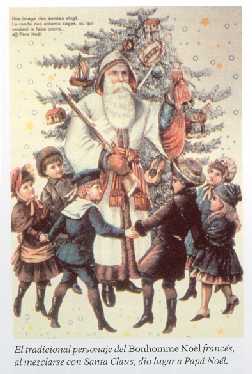
In the middle of the XIX century, the American figure of Santa Claus was exported to England, and later to France, where it was unified with Bonhomme Noel, a bearded character who dressed in white with bright decorations. From this union comes the current figure of Santa Claus, whose definitive appearance was designed in 1931 by Coca-Cola.
The habit of giving gifts to children in Christmas appears in the Ancient Era. Rome dedicated a festivity in December to Saturn (Chronos for the Greeks), in the end of which gifts were received by children. European children received them in later times, coming from very different characters, both religious (Wise Men in Spain) or pagans (the witch Befana in Italy).
Later on, Saint Nicholas replaced most of these characters. Since 1822, the Santa Claus visit is represented on Christmas Eve. Its adoption was very successful in the US because it satisfied a needs of the American society, as gifts were equally given to protestant, jewish, orthodox or lay children. Currently it is a pagan symbol accepted all around the world.

Sunday, November 19, 2006

Looks

Western civilization, since the end of Middle Ages, expanded progressively out of its environment, exploring new territories and discovering strange cultures, very different from its own. Towards them, the discoverer imposed a dominating attitude in the beginning. However, the perception on new civilizations and its population has hugely changed, along with the way of thinking and social changes in Occident.

XV to XVII centuries: The "savage"

Since XV century, Portuguese naos and Spanish caravels, to which other European empires joined later, explored the coasts of unknown continents, establishing colonies and forcing natives to assimilate their culture or exterminating them.
The conception of these new cultures is represented by the way to denominate them: "savages". This automatically puts them in a culturally inferior degree. Colonizers do not respect their customs, destroy their systems. As best, they experiment a simple curiosity for the rare items they contain. It is not rare to see an aristochrat that acquires an elephant tusk, an exotic music instrument or a mummified native, to show to his friends.
Representations of savages usually show their bodies as hairy and monstrous shape, and almost always in a wild and cannibal scene. Western mentality of that moment, very influenced by religion and superstitions, and reluctant to new points of view, naturally led to this monstruous concept of the new and unknown.

XVIII and XIX centuries: The scientific, artistic and social interest

With the arrival of the Enlightment and the use of reason, there starts to be a more constructive curiosity towards exotic cultures. Firstly, a purely scientific interest made antropologists and doctors from Occident study the differences and similarities of these "new people" to the known ones, as well as their way of living.
XIX century is the period of romantics, of explorers and adventurers. This is a perfect scenario for people like them. New territories are charted, scenes of tribal life are painted, and travel books that tell about rites and customs of these civilizations are written. It is the century of people like Livingstone, Stanley and Burton.
At the end of the century and beginning of next one, the positivist movement motivates to classify everything in the World. Naturalists and botanists travel around the Earth classifying new species, taking photos of animals and plants, and take information on non-civilized tribes that exist on the World.
From XX century: Integration

It is only in the past century that a value starts to be given to these cultures, that Western civilization assimilates their cultural contributions and artistic shapes. Modern painters, such as Pablo Picasso and André Breton, among others, among many others, integrate forms and aesthetics directly copied from African and South-american symbolic sculpture.
Globalized World is becoming a mix of trends that lead to a kind of world art. Cultural integration is greater, different lifestyles are adopted. Oriental philosophy and African music get mixed with western customs in an armonic way. Finally, we got to the product of several centuries of human evolution.