Showing posts with label Characters. Show all posts

Sunday, December 02, 2007

The red explorer

A medieval Saga tells the story of Erik, called "the Red", one of the greatest Viking explorers. The appelative "the Red" most likely refers to his hair color, and perhaps also his fiery temper. He was born in around 950 in the Jaeren district of Rogaland, Norway, but his family settled in western Iceland after his father, Thorvald Asvaldsson, was banished for murdering a man. Wandering would become a habit during his life. So, they occupied land in Hornstrandir, and dwelt at Drangar, where he became a Norse Chieftain.

Continuous banishment

After his father's death, he got married and moved south to Haukalar. There, when his servants were clearing land for farming, they accidentally started a landslide on his neighbour Valthjof's farm. A kinsman of his, called Eyjolf Saur, killed the servants for this misfortune, and in revenge, Erik killed Eyjolf. This caused him to be thrown out from the region and installed in Sudrey.

Around the year 982, tragedy accompanied him again in a quarrel with his neighbour Thorgest, because of some beams he had borrowed from Erik and was never given back. When Thorgest refused to return them, Erik stole the beams back. A great fight arose, where two sons of Thorgest died. Eventually, at the next Thorsnes Thing event, where judgments were carried out annually, the Icelanders decided to convict Erik of these murders and banished him from Iceland.

Erik the Red, considering that he was never welcomed in any land, decided to find one by himself. He had heard of a discovery of new lands in the West, around 50 years before, by the explorer Gunnbjorn, son of Ulf the Crow. He then prepared a ship and left from Snaefellsnes, promising to return if he found the land. His friends Thorbjorn, Eyjolf and Styr, and other crew, joined him in his banishment.

After three weeks, he eventually reached North American lands and rounded the southern tip of a great island, and sailed up the western coast. He found it unpeopled and, for the most part, ice-free and consequently with conditions that promised growth and future prosperity. According to the Saga, he spent his three years of exile exploring this land and naming its places.

The New World

When Erik returned to Iceland, he brought with him stories of the new land he called "Greenland". Although the high medieval climate was milder than it is today, Erik purposely gave the land a more appealing name than "Iceland" in order to lure potential settlers. He explained, "people would be attracted to go there if it had a favorable name". Ultimately he did this, though, to gain favor among people, as he knew full well that the success of any settlement in Greenland would need the support of as many people as possible.

His salesmanship proved successful, as around 600 people, especially among those living on poor land in Iceland, joined him to Greenland in the Spring of the year 985, in what was one of the greatest Arctic expeditions of all time. 25 ships left Iceland in that dangerous voyage, of which 14 arrived to Greenland. They established two colonies on the southwest coast: Vestribyggd (West, close to present-day Godthab), and Eystribyggd (East, in modern-day Julianhab). In the latter Erik built the estate Brattahlid, from where he ruled his colonies as Paramount Chieftain, a respectable title that practically gave him independence in his lands from Iceland. Although these facts are told as a legend, carbon tests performed on archeologic remains of what is thought to be Brattahlid give this date as accurate. There the first Greenlandinc Thing (parliament) was founded based on the Icelandic one. Laws were not centralized but decided by the people, and not written down, but memorized by an elected Lawspeaker. The first Christian church in the New World, Thjodhildakirkja, was also built in there by Erik's son Leif Eriksson.

In the next years more settlers arrived from Scandinavia and gradually occupied all the southwest coast of Greenland, which was actually the only area suitable for agriculture. There were around 400 farms in the territory, which reached 5000 people in its best time. During the summers, armies of men were sent to hunt above the Arctic Circle for food and other valuable commodities such as seals, ivory from tusks, and beached whales. In these expeditions they probably encountered the Inuit (Eskimo) people, who had not yet moved into eastern Greenland.

Commerce flourished with Iceland and Norway. Greenlanders exported ivory, ropes, sheep and furs. Iron and timber, not present in the island and necessary for building, were brought from Europe to chieftains, who distributed it among the surrounding farmers. Although the colonies' dependence on these goods was high, trade was very active since Greenland ivory was very appreciated in Europe, as the trade of elephant ivory had been blocked by conflicts with the Islamic world.

In 1002, a group of immigrants brought an epidemic that ravaged the colony, causing Erik's death. However, the colonies survived and rebounded again under the protection of the king of Norway. In 1126, Norvegian control grew by founding a diocese dependent on the archdiocese of Trondheim. In 1261 the population finally accepted the overlordship of the Norvegian King and started paying tributes, although it continued to have its own law.

Decline started in 1348, with the arrival of the Black Death and the Inuit attack to the Western Settlement. Since 1380, the trade with Europe gradually declined, stressed by the prohibition of all private commerce by the new Danish government of the Kalmar Union in 1397 and the loss of interest in the colonies. The population had to be excused several times from paying taxes, and archeologic findings show an increasingly empoverished diet for men and animals. In 1418, English pirates sacked the Eastern Settlement and by the end of the 15th Century, the Norse population of Greenland had disappeared. The most probable ultimate reason for the abandonment of the colonies was that climate became colder in what is called the "Little Ace Age". Moreover, the Norse never learned the Inuit techniques to adapt to cold winters, kayak navigation or ring seal hunting.

The sons of Erik

Erik's son, Leif Eriksson, also made History by becoming the first Viking to explore the lands of Vinland and Markland (present-day Newfoundland, in Canada) around the year 1000. Settlement there resulted a disaster, since the colony Leifbundir only lasted ten years. The reason was the continuous conflicts with what they called "skraelings" (literally, "ugly men"), who, in the first contact, killed Leif's brother Thorvald. Fights were usually won by Vikings, but they soon realised that establishment was impossible without a military support, and travelled back to Greenland. They returned periodically to gather timber for building, as the journey was far shorter than going to Iceland. The last known journey to Vinland dates from 1347.

Sunday, April 22, 2007

Why did Descartes die?

René Descartes, the man considered as precursor of Scientific Method and author of revolutionary books such as his Discourse on Method, died in obscure circunstances that were not cleared out until recently.

In 1646, the impulsive Queen Kristina of Sweden, ethusiast of Arts and Philosophy (although not with deep thoughts, as Descartes himself admitted), started to write letters with the philosopher, who was at that time retired in Nederlands. Impressed by his teachings, she invited him to the Swedish Court as a guest to give her lessons on Mathematics and Philosophy. This was part of her plan to be surrounded by great European thinkers and transform Stockholm into a cultural centre.

After some forceful "invitations", for which the queen sent one of her admirals, and later even a warship, in 1649 Descartes reluctantly accepted her proposal. In Stockholm he was received with high honours, incorporated to the Swedish aristocracy, and granted conquered lands in Germany.

Death at the Court

He did not enjoy life in the court, however. Apart from some punctual jobs (such as some lines in French for a ballet, or plans for the Swedish Academy) he only had to teach the queen during the mornings. The problem is that Kristina got up extremely early, and scheduled their lessons at 5 in the morning in the middle of Swedish winter. This was very hard for Descartes, who was used to stay in bed reading and thinking until noon. He usually said, "men's thoughts freeze here in winter, same as water". Five months after his arrival, the 11th February 1650, he died.

The official version of the time was that he died of pneumonia. After treating the French ambassador in Stockholm, who had contracted this contagious illness, Descartes got also ill and died one week later. Considering he was not used to nordic cold, this seems plausible. He was buried in a cemetery for unbaptised kids (because he was a catholic in a protestant country), and some years later his remains were moved back to France. Closed case.

However, the French ambassador, Hector P. Chanut, graved this quote in his headstone: "he expiated his rivals' attacks with the innocency of his life". So, he could have been murdered. There was enough reasons actually, as he was a catholic with more influence than most nobles. He could have been considered dangerous and cause of the Queen's catholicist trends (who, four years later, abdicated, converted, and moved to Rome).

Proof of the lie

In 1980, by complete chance, the prove was found. The German scientific Eike Pies, reviewing letters from his ancestor Willem Piso at Leyden University (Nederlands), saw a letter sent to him by Johann van Wullen, personal doctor of Queen Kristina and witness of Descartes' agony. In that letter, the details on the symptoms are described day by day: weakening, vomits, diarrhoea, dizziness, skin's pigmentation, cutaneous damages, entheritis... symptoms commonly found in an Arsenic intoxication.

So, Descartes was almost certainly poisoned. How was the truth hidden? In the letter, Wullen points out that the Queen asked to read it before being sent, and ordered that it never fell in strange hands. Kristina probably wanted to save the prestige of Swedish monarchy, already target of rumours and palace intrigues because of the Queen's excentricities. This way, the murder was never investigated. And History books still tell the "official" version of the facts.

Saturday, November 25, 2006

Xian Yu, the general that almost got China

The year 210 BC, the emperor that established the Qin dynasty in China dies. His son, a complete idiot, could not avoid a general uprising in the empire, that would lead to his fall.

In the south, in the rural region of Chu, a coalition of rebel armies advanced towars the Qin capital, Guanzhong. It was agreed that the first general that conquered the city would be the heir to the throne. Of the candidates, Xian Yu was the most admired, but also the most feared.

A doubted reputation

Xian Yu was nephew of Xian Liang, the soldier that had started the revolt. After his death in battle, Xian Yu took it over from him, and he unstoppably fighted and defeated the imperial armies. His cruelty, however, was not less known. He razed entire cities, killed hundreds of thousands of people, and murdered members of his own coalition. In the battle of Julu, having been put under command of the general Song Yi, he did not hesitate to killing him when he had shown indecision, and commanding his army, risked it and produced an enormous defeat to the iperial troops, despite of huge losses of his part too. He was awarded a doubted reputation of brave and militarily skilful man, but also arrogant and tyrannic.

Xian Yu forgot the agreement that had been made. While he was fiercely fighting in Jusu, a small army led by the unknown Liu Bang entered the weakened empire and conquered the capital, being thus appointed future heir of it. When Xian Yu arrived there and noticed it had already been conquered, he got furious and razed it.

A violent five-year civil war happened between the two factions. Xian Yu had more support, more territory and a better equipped army. However, after some defeats, Liu Bang began winning. Despite of his less military experience, because of his humble origins, he carried out a successful diplomacy. He got surrounded by good military advisers, attracted of the more noble and calm personality of Liu Bang than the one from his adversary. Meanwhile, Xian Yu never accepted a single advise from his lieutenants and only trusted the bravery of his soldiers.

In the end, the better strategy, and especially the management of supplies, gave victory to Liu Bang, who became the first emperor of the Han dynasty. Xian Yu cut his throat on the side of the river Yangtse, abandoned by all his lieutenants.

Xian Yu is still a very popular character in the Chinese culture. The sentence "being surrounded by Chu music" means being without allies or support. It comes from the moment when Liu Bang's army surrounded Xian Yu, after conquering the region of Chu, from where he was. Liu Bang odered his soldiers to sing typical songs from the region, so that they showed him that they were on his side there too.

Tuesday, October 24, 2006

The true Robespierre

Robespierre is one of the main characteres in the French Revolution, but also that sanguinary tyrant who sent thousands of people to guillotine during the Terror era. However, the ones who write History are usually the winners of the moment, which in this particular moment were the enemies that provoked his downfall. Let's try to be more critical.

A respectable citizen

Maximilien Robespierre was born in Arras, in the French Picardie. From a middle-class family, he could follow Law courses as his grandfather, where he stood out as a particularly brilliant student. While working as a lawyer, he wrote several law books that gave him a good reputation in the town. Being known as an inconditional supporter of Rousseau's revolutionary theories, he was one of the most respectable citizens of the region, being especially known for his correction, honesty and absolute sincerity.
In 1788 revolutionary ideas became more popular, and Robespierre started influencing political ambiances in the town, where he was chosen for several political jobs in Arras and later in Paris, where his position in defense of poor peasants granted him the support of the people while his brilliant speeches. He entered the Jacobins Club, the radical left-wing group, of which he eventually became the spiritual leader after the disappearing of its founding leaders (Barnave, Mirabeau). The attitude Robespierre took during the events that followed, and especially the speeches in which he exposed it, gave him an increasing popularity within the Revolutionary Government, which eventually lead him to be elected as a member of the Public Security Commitee. He had opposed the war with Austria, and had supported the execution of King Louis XVI, by pronouncing his popular sentence "Louis must die, so that the country can live". The failure that the contrary position Girondins took meant their destruction, and the consolidation of Robespierre as the leader of the National Convention, new era of the Revolution.
From 1792 to his downfall two years later, more than 30000 people were guilotined in Paris, denounced by the Convention as traitors to the Revolution. Robespierre and his little buddies increased progressively repressive actions, also among the members of the Government. Danton and Hébert, supporters of Robespierre but from different factions, were executed, and the Government was increasingly pointed out as a dictatorship. Finally, a raising of the people provoked the Convention overthrown and the execution of its tyrant, in July 1794.

A cruel tyrant?

It is uncontested that Robespierre created an authoritary and repressive state, almost a dictatorship in the middle of the Revolution. However, which were the reasons for his actions? Actually, a personal dictatorship does not match with the ideas he defended, and maybe he never really liked sending citizens to the guillotine (he dismissed from a judge job at Criminal Court of Arras to avoid pronouncing death sentences). It is imaginable that after the overthrown of the Convention, many members of the Commitee blamed Robespierre, already dead, for all the atrocities that happened, and so saved their lives.
Robespierre was a theorist and a philosopher. During his political career, he formulated laws, wrote essays and gave speeches. The ideas from his idol Rousseau, which defended the people's power especially over individual freedom, were the defining ideas of his Government, that he described as "the despotism of freedom against tyranny". As a theorist, he tried to apply his ideas in an inflexible way, to the point that he did not hesitate to eliminate his detractors. As a politician without pragmatic sense, he never betrayed his ideas, and was "incorruptible" until his death.

Tuesday, October 03, 2006

The Queen of Sabah

The story of the Queen of Sabah is one of those cases where true is marred by legends. Despite of being mentioned in many ancient writings, the authentic identity of this woman is still unknown.

The story

Several Holy books, such as Judaic Bible, Islamic Quran and Ethiopian Kebra Nagast tell about a queen who ruled in the southern Kingdom of Sabah (or Sheba in Hebraic) with great kill, as she was loved and feared by her people. It is told that "she lived with luxury, and she had a magnificent throne" (Coran, 27). Personally she was very brune, and beautiful, but also with a strong will.
Even when no name is ever given to her (although Ethiopian tradition calls her Makeda, and Arab calls her Bilqis), Judaic texts mention that the queen heard from the greatness of King Solomon and decided to visit him, carrying with her big amounts of spices, gems and gold as a gift. She could even have been invited by Solomon himself.
Different versions agree that during her 6-months stay in Israel, Solomon made use of his seduction arts towards her, by which he was well known (this charming sir had more than 700 wifes and concubines). According to the Judaic Bible, she was so impressed by his culture that in the end she converted to Judaism and set this religion in her homeland when she returned. Ethiopian tradition affirms that from the union of both a child was born, whose name Menelik, who, at his mother's death, was the first of an extraordinary long dinasty that ruled Ethiopia, lasting to the popular emperor Halie Selassie and his descendents.
However, scarce archaeological evidences make it very hard to know the true story of this queen. How could someone, who takes such an important role in legends and Holy writings, leave so few traces of her existence?

The History

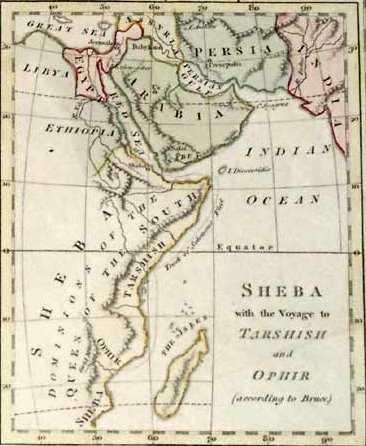
Let us see. What does seem certain is that in the X century BC, as Israel reached the maximum of its cultural and political power under Solomon's rule, there was a kingdom at the gates of the Red Sea which occupied a great part of current Yemen, and probably coastal regions of the Horn of Africa.
Sources different from the already mentioned say that the city of Tyre "traded with the merchants of Sabah and Ramah: first quality spices and every kind of gems and gold they gave for their goods" (Ezechiel, 27), agreeing in what the Bible mentions. Also Assyrian and Persian writings testify its existence. It seems that, despite being a much less refined culture than the Israeli one, its privileged situation confered it quite a great importance at this time.
Recent archaeological findings have shown an urban centre in Marib, currently Yemen, at what is supposedly the heart of the ancient kingdom of Sabah. Findings in Ethiopia have not been so revealing, although the presence of semitic origin languages concentrated in the coastal zones of Ethiopia, Egypt and Somalia suggest that at least these areas probably belonged to this culture.
About the existence of the queen, the absence of a name to give her is something awful (in the historical sense). But actually, it is not really known whether she existed or not. Holy writings, so prone to allegories and myths, could perfectly have told about the queen in a symbolic meaning.
In the findings at Marib there is a temple known as Temple of Bilqis (the name given to the queen by the Arabs). Hence, maybe the queen, as it was a civilization mainly matriarchal, became a godness. It could even be, why not, that writings do not tell about the Queen of Sheba but on the Godness itself, in a symbolic meaning. However, pagan religion in this kingdom was polytheistic, so we could be just reducing the legendary queen to a simple local divinity from the supposedly capital Marib.
The fact of the visit to Solomon is not generally seen as a legendary tale, but it could also admit several meanings. The most widely accepted is the sign of a commercial treaty between the kingdoms of Israel and Sabah. Trading goods carried by the Sabaeans to Israel seem to prove it. However, it is possible instead that the king Solomon, seeing a kingdom with great commercial power but militarly inferior, would have forced a submission treaty by which Sabah would have become a mere vassal of Israel. This could give an explanation to the fact that Judaism expanded over southern Arabia and Ethiopia.
The switch of reality into legend could have happened in a natural way. King Solomon liked to be surrounded by a court of poets and singers that told the deeds of his king. These heroic songs could have become tradition, which 400 years later would have been impressed in Judaic writings, from there passed to Quran, and from there to Legend. Et voilà, the myth is over :)