Thursday, August 23, 2007

Holidays

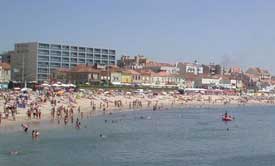
Just arrived from holidays, it seems to me appropriate to tell why we have leisure days, who decided when they would happen, and since when we do tourism at the seaside or the mountain.

Origins of holidays

Originally, resting days were given by religious festivities or natural cycles. While the population was mostly rural, the main resting period (that coincided generally with the celebration of festivals) was after the harvest time, in a period varying from August to December.
The first journeys due to celebrations were pilgrimages to religious centres (Oracle in Delphi, Mecca, Temple of Mahabodhi, Way of St James, etc), or cultural events, such as the Olympic Games, and were made very few times a life. It was already common in these journeys to bring "souvenirs" back home. In the end of the Middle Age the first establishments known as "hotels" appear, created to accommodate important people who traveled with their entourage. Rich classes, moreover, used to have a villa or palace as alternative residence, often near the sea, where climate was mild. Some places were starting to stand out such as Baiae (Italy) during the Roman Republic.

Modern Age: English-like tourism

It is during the 16th Century that the interest of travelling and exploring new places. In England it becomes fashionable among the aristocracy to send the young men for a "Grand Tour" (from there came the word "tourist") during several years in order to complete their studies and have new experiences. At this time also baths are reborn (now as bath centres far from cities) and beaches, where first the English Royal Family moved (Weymouth, Brighton, etc.) and then spread among rich people, just for imitating. The renewed interest in topics such as Botanics, Archeology or Paleontology gave way to interest of hiking during the months in Spring and Summer.
The 19th Century witnesses the revolution in transports and the apparing of railway lines and transoceanic boats that make long journeys easy and cheap for the new burgeoisie, less elitist than ancient aristocracy, and also with time and money to spend. Health tourism is generalised, and beaches are joined by mountain: it is the time of mountaineering and sanatoria. The first entrepreneur iniciatives. mostly English, related to tourism appear: the first travel company "Cox & Kings" (1758), the first transoceanic company "Black Ball Line" (1818), the first organised trip by Thomas Cook (1841), the first travelers' cheques by "American Express" (1891) and the first comfort hotels by Cesar Ritz (1898).
It was also the English who, looking for a new leisure season, started Winter tourism in the Swiss villages of Zermatt and St Moritz in 1864, where the first ski resorts. This fact coincides (not by chance) with the invention of modern skiing by Sadre Norhein (1825) and his technique of "telemark".

Modern Tourism

Since the 1950s the "boom" of tourism in Western World takes place, thanks to political stability, elevation of standards of living, generalisation of cheap automobiles and urbanisation of society (that generates a new culture of leisure based in fleeing from stress of daily life). It is also then when tourism becomes massified: first the vehicle trip to the seaside, and then, when the reaction airplane appears, tourism packs to exotic destinations. During the 1960s all the aspects of tourism are legislated (insurances, rights of passengers, paid holidays).
Modern tourism dates from the 1980s, when it becomes diversified in many different types (cultural, rural, health, risk tourism), characterised by the liberalisation and internationalisation of the big tourism companies and the free exchange of people inside the European Union. Also recently appears the backpacker, a kind of independent tourist with few resources, and also low-cost flight companies. These are lately generating a new conception of tourism based on do-it-yurself and freedom, in a World where individuals have already enough education and power to do so.

Thursday, June 21, 2007

Two Germanies

A brief timeline of the process that meant the division of Germany after the Second World War.

12 - 16 September 1944: During the Quebec Conference, the Morgenthau Plan for the occupation of Germany is approved. This plan aimed to dismantle the whole German heavy industry and transform the country into two independent "agricultural States", in order to avoid future rearmaments. The Plan was finally rejected, but was a guide for the later process.

8th May 1945: Inconditional surrender of Germany, carried out by marshal Doenitz. 15 days later, the German General Staff is arrested.

5th June 1945: Establishment of the Allied Control Council, based in Berlin, for the government of the occupied Germany, with shared powers among USA, Soviet Union, United Kingdom and France.

End of May 1945: Brno Death March. 24000 Germans from the Sudetes are forced to walk towards the Austrian border, expelled from Checoslovaquia. Nearly 1000 die of violent treatment and disease.

17th July - 2nd August 1945: Potsdam Conference. Division of Germany and Berlin in 4 territories administered by USA, Soviet Union, United Kingdom and France. The Soviet Union unilaterally modifies the German border with Poland to the Oder-Neisse line. Forced expulsion of the German and mixed population from all the Eastern Europe countries is agreed. This will mean more than 14 million migrations during the next 4 years. According to the Morgenthau Plan, the reduction of the German heavy industry is agreed, as well as a control to its Foreign Trade. However, no agrement is reached about occupation, as the Soviet Union claims a single demilitarized state under its rule.

January 1946: Beginning of the "denazification" process.

5th March 1946: Benes Treaties are ratified, which state that all property belonging to German residents in the Sudetes and expelled from Checoslovaquia are expropiated by the State as war payments. Germany starts becoming a country without practically any resource to fee an excessive and poor population.

29th March 1946: First Desindustrialization Plan for Germany begins, which aims to reduce heavy industry to 50% of the pre-war levels. Steel and automobile production is stricted, and the one for drinks, domestic goods, timber and Coke is promoted.

March 1947: The "Truman Doctrine" is made public, that defends contention towards emerging Communism. The Cold War begins.

Winter 1946-1947: A specially harsh winter, the situation of German population becomes unsustainable due to lack of food and fuel. Infant mortality in the country is double than that of Western Europe.

12th July 1947: Marshall Plan is proposed. The Soviet Union rejects it and forces all the States in Eastern Europe to do so, as a first relevant distancing between Allied powers.

July 1947: American occupation in Germny is more and more impopular. USA decides to cancel the current occupation directive, and substitutes it by another that aims the re-industrialization of Germany. The president Truman wants to recover an economically strong ally in Europe, over which to develop the damaged continental economy, and avoid that the low standard of living in the country leads to a Communist coup. France prefers keeping the hard directive. The Soviet Union is frontally opposed to the change, and goes on with desindustrialization (in its case, movement of German industry to Russia) in its zone.

January 1948: USA extends the Marshall Plan to Germany, and promotes the currency reform by introducing the German Mark in its occupation zone in June.

March 1948: The Soviet Union retires from the Allied Control Council, as a response to the economical measures taken by Western powers in their zones. A Communist system starts to be installed in its occupation zone and Eastern Berlin.

24th June 1948: The Soviet Union imposes the terrestrial Blockade to the three Western zones of Berlin through its occupation zone, alleging that the guarantee of this communication had never been signed. General Clay proposes the advance of an armored column towards Berlin, with orders to open fire if attacked. The Truman government rejects the proposal as "too close to a war". It is agreed instead to supply the city with three air corridors (one managed by each Western ally) using civil and military aircraft.

4th April 1949: NATO is created as a pressure means to the Soviet Union.

11th May 1949: The Soviet Union ceases the Berlin Blockade, due to its ineffectiveness and international pressure. 65 Germans, Americans and British have died during the supply operations, specially difficult due to obstructions imposed by Soviets.

23rd may 1949: The government of the Federal Republic of Germany is established in the territories occupied by USA, France and United Kingdom, with capital in Bonn. Western Berlin remains under the status of American military occupation, although its residents are granted German citizenship.

7th October 1949: The USSR creates the Democratic Republic of Germany, with capital in Berlin. The country, not internationally recognised, remains under Sovietic occupation.

1952: Due to the flow of Eastern Germans towards the West, the USSR closes the borders and establishes controls.

May 1955: Eastern Germany's status is switched from occupied territory to Soviet Union allied.

14th May 1955: The Warsaw Pact is created. Eastern Germany joins it in 1960.

13th August 1961: Thousands of Eastern Germans still trespass daily the border through Berlin. The government of East Germany, under the approval of the Soviet Union, starts boulding the Berlin Wall in order to close this hole, alleging the needs to raise an "anti-fascist protection barrier".

July 1962: The "Death Strip" is created, a fully watched space close to the Wall by its Eastern part. House suburbs are pulled down in order to leave an open space that eases shooting from watch towers. Until its destruction in 1989, it is calculated that around 200 people died tryin to jump the Wall.

21st October 1969: Willy Brandt becomes chancellor of Federal Germany. Under his rule, the Ostpolitik is promoted as a process of rapprochement and diplomatic normalization between the two Germanies. At a long term, this will mean the international recognition of the existence of two independent sovereign States, and the inmobility of their borders (after the Moscow Treaty in 1970).

Thursday, June 07, 2007

Europe of the Regions

The 1986 Single European Act was the first major revision of the Treaty of Rome that created the European Economic Community in 1957. The Act meant a commitment of joint progress, and a new manner of coordinating economic activities, after the failure of semi-plannified economy and the collapse of the Bretton Woods system (dependent on the dollar) that happened during the 70's.
The result of the Act was the creation of the European Monetary System (called "of the European snake in the tunnel", as European currencies were floating in group against the rest). This was the first step to the arrival of the euro economy.
Another wanted step was the administrative reform of the recently named European Union, which was becoming more and more complex when taking joint decisiones (the system of national vetoes made agreements very long or impossible).
However, no political topics were treated (the absence of a common Defense and Foreign Affairs) nor many economical (such as the aberrant agricultural budget applied since the entrance of Spain and Portugal). But the countries agreed on one thing: reaching a free market of goods and work.
So, the decision-taking system was almost only economic. In order to ease it, the national agreement system was switched into another one in which regions had direct access to the European Council in Brussels and could act independently from their corresponding national entity. The Europe of the Regions started existing.

A new imbalance

The result was a modification of budget decisiones taken by the European Regional Development Fund (ERDF), which identified backward European regions and distributed investments in order to estimulate their economies. Now regions avoided their Governments, not generally very willing to cooperate in regional investments. Some of them, generally the richest (such as Catalonia and Baden-Württemberg), established their own offices in Brussels to constitute true lobbies.
Consequence? The richness desequilibrium was not reduced (rather the contrary), but it was redistributed by regiones instead of countries. Now, a group of first order regions existed (Lombardy, Catalonia, Flemish Region, Baden-Württemberg, Bavaria, Rhône-Alpes...), and another group of poor ones (Andalusia, Scotland, Wallonia, Algarve...). A new, costly bureaucracy, that did not doubt when manipulating subsidy data, intensified the problem.
In conclusion, Europe, without solving its old defects of clientelism and corruption, just diluted them into a new structure where abuses still often happened. Economic rforms based in the 50's and 60's way of thinking (already shown inefficient) unlegitimated a bit more a Union that, nowadays, is clunking and needs real measures.
Definitely, it was successful in one thing: the appearance of a new way of regional sub-nationalism. It is not a coincidence that in the most subsidied European regions, this regionalism passed from a traditional reactionary folklorism to a conscience, sometimes independentist, in which a disdain towards governmental identity, but also an Europeist supra-national thinking has invaded their inhabitants.

Sunday, April 22, 2007

Why did Descartes die?

René Descartes, the man considered as precursor of Scientific Method and author of revolutionary books such as his Discourse on Method, died in obscure circunstances that were not cleared out until recently.

In 1646, the impulsive Queen Kristina of Sweden, ethusiast of Arts and Philosophy (although not with deep thoughts, as Descartes himself admitted), started to write letters with the philosopher, who was at that time retired in Nederlands. Impressed by his teachings, she invited him to the Swedish Court as a guest to give her lessons on Mathematics and Philosophy. This was part of her plan to be surrounded by great European thinkers and transform Stockholm into a cultural centre.

After some forceful "invitations", for which the queen sent one of her admirals, and later even a warship, in 1649 Descartes reluctantly accepted her proposal. In Stockholm he was received with high honours, incorporated to the Swedish aristocracy, and granted conquered lands in Germany.

Death at the Court

He did not enjoy life in the court, however. Apart from some punctual jobs (such as some lines in French for a ballet, or plans for the Swedish Academy) he only had to teach the queen during the mornings. The problem is that Kristina got up extremely early, and scheduled their lessons at 5 in the morning in the middle of Swedish winter. This was very hard for Descartes, who was used to stay in bed reading and thinking until noon. He usually said, "men's thoughts freeze here in winter, same as water". Five months after his arrival, the 11th February 1650, he died.

The official version of the time was that he died of pneumonia. After treating the French ambassador in Stockholm, who had contracted this contagious illness, Descartes got also ill and died one week later. Considering he was not used to nordic cold, this seems plausible. He was buried in a cemetery for unbaptised kids (because he was a catholic in a protestant country), and some years later his remains were moved back to France. Closed case.

However, the French ambassador, Hector P. Chanut, graved this quote in his headstone: "he expiated his rivals' attacks with the innocency of his life". So, he could have been murdered. There was enough reasons actually, as he was a catholic with more influence than most nobles. He could have been considered dangerous and cause of the Queen's catholicist trends (who, four years later, abdicated, converted, and moved to Rome).

Proof of the lie

In 1980, by complete chance, the prove was found. The German scientific Eike Pies, reviewing letters from his ancestor Willem Piso at Leyden University (Nederlands), saw a letter sent to him by Johann van Wullen, personal doctor of Queen Kristina and witness of Descartes' agony. In that letter, the details on the symptoms are described day by day: weakening, vomits, diarrhoea, dizziness, skin's pigmentation, cutaneous damages, entheritis... symptoms commonly found in an Arsenic intoxication.

So, Descartes was almost certainly poisoned. How was the truth hidden? In the letter, Wullen points out that the Queen asked to read it before being sent, and ordered that it never fell in strange hands. Kristina probably wanted to save the prestige of Swedish monarchy, already target of rumours and palace intrigues because of the Queen's excentricities. This way, the murder was never investigated. And History books still tell the "official" version of the facts.

Monday, April 09, 2007

History of chopsticks

Following a good comment from K-dreaming about the History of the fork, I have searched about History of chopsticks.

It is commonly admitted that chopsticks appeared in China around 5000 years ago. Before that date, food was taken from big pots in the fire pricked in long sticks directly cut from trees. Later on, with the increasing population, fuel resources became scarce. This slowly lead to a new way of cooking that required less wood, for which food was cut in small pieces so that it took less time to cook. Then food could be eaten directly from the pot, eliminating the need of knives, and tree branches gradually became chopsticks.

Although the most ancient existing pair of chopsticks dates from the Tang dynasty (7th-10th centuries), it is written in the Liji (Book of Rites) that chopsticks were used already during the Shang dynasty (16th-12th centuries BC). Sima Qian stated in his History book, that the last king of the dynasty used ivory chopsticks. According to experts, bamboo and wooden chopsticks should date at least from 1000 years earlier. In the following centuries, bronze, golden and silver chopsticks became fashionable. Specially the latter were popular among aristocracy, as it was thought that silver became black when it was in contact with poison. This belief is exaggerated (actually silver does not react to arsenic neither to cyanide), but there is something true: rotten eggs, onions and garlic expell hydrogen sulphyde, which does change the colour of silver.

Probably, Confucius' teachings contributed to promote the use of chopsticks at the table. He said, literally: "the honorable and correct man is well aware of the differences between slaughterhouse and table. And does not allow the use of knives at his table." Because of Confucius' popularity, who was by the way a vegetarian, this sentence eliminated the Western habit to use knives at the table.

Around the 6th century, the use of chopsticks spread to other countries such as Korea, Vietnam and Japan. Although in Japan it was first used only for religious ceremonies, it soon acquired culinary popularity, and the Japanese even created a new kind of chopsticks typical of their country: with a more sharpened point than Chinese ones, and attached at the base. From the 10th century this attachment disappeared and the became the Japanese chopsticks we know nowadays. They were also spread in Thailand, but in the 19th century the king Rama V introduced Western table utensils, limiting the use of chopsticks only to noodles.

Tools similar to chopsticks were found in the archeological findings in Meggido (Israel), belonging to Scythian invaders of Canaan, and contemporary of Moses and Josuah. This discovery reveals the extension of trade between Middle East and Far East in ancient times. Chopsticks were also common tools used by the Uyghurs in the steppes of Mongolia during the 6th-8th centuries.

Saturday, March 24, 2007

Blue blood

It is interesting to see how nobility titles in Western Europe have changed their meaning along History. Some of them dating back as long as the Roman Empire, during the Middle Ages acquired their meaning related to land ownership. Currently, titles are merely honorific.

Duke

The title of duke is traditionally the one of highest rank. he word comes from Latin "dux", meaning "military commander", and was employed by both Romans and Germans to refer their warrior leaders. In the Roman army, a dux was a general in charge of two or more legions, who normally managed the government of a province (both civil and military). In the Roman Empire, the powers of the dux were limited to strictly military, depending on the governor (normally a "comes") to make use of them. In Byzantium, "dux" became viceroys at the head of every administrative and military service.

During the Middle Ages, dukes became the closest nobility title to the king, and their function was essentially military, with a territorial aspect though, as they ruled in a set of countships. Of course, there exist variations in the meaning of dukes in every kingdom. Frankish dukes were the nobles of highest rank, from where province governors came out, although they also appear leading military expeditions away from their duchies. Later, Charlemagne restructured administratively the kingdom, multiplying the number of counts and reducing that of dukes, limiting it to the nobles closest to him. In Spain and Italy, Visigoth and Lombard dukes, respectively, were the greatest land owners and, together with bishops, they elected the king among them. Although the were nominally loyal to the king, the concept of monarchy was new for them and dukes acted independently from royal authority, specially in central and south Italy, where the duke of Spoleto and the duke of Benevento were sovereigns de facto. Also in Germany, duchies were independent kingdoms inside the Holy Empire, and in Italy, "doges" were the heads of state in some of the Republics in the peninsula (Genoa, Venice). In modern times, variants from this title ("Conde-duque" in Spain, Archduke in Austria) to refer the head of state.

Count

Etimologically from the Latin "comes", which means companion or delegate of the emperor during the Roman Empire. Its origin is in the people surrounding Augustus ("amici Augusti"), normally selected from senators, who when travelling became "comites Augusti", being their role just that of personal advisors. They disappeared with Alexander Severus and created again under Constantine, when they designated the most loyal to the emperor, being a hierarchy over regular officials. They had a political and administrative role, with military functions specially when defending borders.

During the Germanic kings, counts were designated by a dux or the king. The title of count was indistintively given to every official around him, one of which, the count palatine ("comes palatii"), was in charge of rendering justice inside the palace. Some arms companions of Frankish merovingian princes received the title for city administration. At these times they start to have fiscal, military and judiciary functions. Military power only never depended on a moving army, but settled on a territory (countship). In the countship, he rivalised mainly with the bishop (in his corresponding diocese) for the use of power. Under Charlemagne, counts were given a specific mission (military or administrative) with temporal character, and never hereditary. It is only after the 9th century that counts start to form a land owner class, usurpating royal rights over their countship land. The title was also often given by the monarch as gratitude for a special service, without necessary being accompanied of a feudal territory. In England, there exists the equivalent "Earl", term originated in Scandinavia.

Marquess

The original title comes from German "markgraf" (literally "count of the mark"). During the High Middle Ages, and specially in the Carolingian Empire, it was a count who administered a border territory (mark). In order to allow him a quick reaction to potential attacks, special military powers were given to him to raise up the army without the express permission of the king. This authority has later conferred it a higher rank than the count, but lower than the duke, as the latter has a military and judiciary power over several countships. After the collapse of the Carolingian Empire, the marquis title fell into disuse, except certain counts who proclaimed themselves marquis to acquire greater importance (that is the case of the count of Barcelona, who justified this action for being situated in the border with hispanic Muslim kingdoms). In modern times it resurected as an honorific title.

Baron

Etimologically coming from a mixture between the Frankish word "baro" ("warrior") and the Angle "beorn" ("noble"). Since the Middle Ages, it refered those who had obtained privileges directly from the king because of a military service, situated just over the title of knight. Acording to the country, the meaning was different: In France, for being baron, it was required to possess at least two castles. In Spain barons were the rich and magnates who participated in political sessions. In the Holy Empire, every family in the low nobility were granted the title of baron (distinguished with the prefix "von"). The English king Henry II made a distintion between greater and lesser barons. Since the 16th century, baronship looses its relation with land ownership, becoming a nominal title.

Monday, March 12, 2007

Shadow plays

Shadow play is perhaps the most ancient scenic art in History. It is based in the projection of articulated puppets in front of an illuminated background, causing sensation of movement. During thousands of years, it has entertained and taught both humble and aristocratic classes, specially in Asia, where it was originated.

China: Poems and romances

According to the legend, Chinese shadow play dates back to the Han dynasty (3rd BC-3rd AD centuries), when an emperor lost his favorite concubine. A taoist monk used a shadow to evoke a feminine shape, which the Emperor believed was his reborn lover. What is certain, is that in the time of the Tang dinasty (7th-10th centuries), it was a popular entertainment very spread in the provinces of Shanxi, Shaanxi and Hebei, which later passed to Beijing. During the Ming period (XIV-XVII centuries) it was not exclusive of the lower classes anymore, and passed to the aristocracy and imperial family.

In China, puppets were small and made of paper or leather. A puppeter handled them with three sticks (one for the head, one for each arm), and made the voice of every character, while a small orchestra accompanied dramatic scenes (specially many "gongs"). There were four defined types of characters: men (sheng), women (dan), painted faces (jing) and clowns (chou), each of them with a specific symbolism and function.

Although this genre gave way to many regional styles, thematic was essentially the same: Buddhist teachings in the beginning, romances and epic lyrics later (the one referring to Liu Bang and Xian Yu was very popular, see previous post).

India: Mediator between men and gods

It is not known with certainty whether the shadow theatre appeared in India, Thailand and Indonesia originating from China or had an independent evolution. There are major differences, such as the puppet size (it was normally human in India, its size showing the character social rank though), and its lower articulating ability. Used matierals were coloured and translucent, leading to a much colour and surreal aspect.

This oniric effect has perhaps influenced its final significance. In the Indian region, shadow theatre was the main medium to express the supernatural, very used for the spreading of mythical Hinduist literature, the Ramayana and the Mahabharata. Performances even became rites with the powers of bringing rain and healing the sick and possessed.

In India, the puppeteer job was something hereditary, and almost sacred. Entire wandering families were in charge of building puppets and performing, being considered as some kind of priests. Nowadays, Indian shadow play is in decadence, except for the Wayang Kulit in Java, which enjoys an official protected status.

Turkey: Political satire

Maybe brought to Persia and Middle East by Gengis Khan's conquests, Turkish shadow theatre has Chinese influences. However, due to its colourful aspect, it is widely accepted that it comes from Ancient Egypt and Java, with influences from Greek phylosophy.

Featured characters evolve to the point of having a very defined symbolism, and the same appear in every performance. Most important are Karagoz and Hacivat (the first, showing his common sense, the latter his education), the courtesan Sitt al Husyn (who represents Love), and the doctor Mustapha (who symbolises power and corruption). The meaning was essentially satirical and didactical.

First described by Ibn Danyal in Cairo, during the 16th Century is spread in the Ottoman Empire. There it acquired great popularity, specially in Turkish cafes during the month of Ramadan and in Muslim feasts. However, it seldom had a religious significance, but instead it reflected social problems of the time, always from a humorous perspective. It was, say, the daily newspaper at that time.

Sunday, February 25, 2007

Human sacrifices to Huitzilopochtli


In summer 1521, the small army of the conquistador Hernán Cortés had been expelled from Tenochtitlan by the Aztecs, 62 of his soldiers taken prisoners during the fight. From outside the lake of the mexica capital, Cortés saw, powerless, the Aztec priests dispose these prisoners on the pyramid-temple altars, opened their chests and offered their beating hearts to the god Huitzilopochtli.

The chronicle of the swordsman Bernal Díaz tells these facts. Ritual sacrifice was perceived by Cortés as a threat and intimidation from the Aztecs. It probably arised a feeling of rejection and revenge in him, that influenced the later extermination of Aztec culture. However, the ritual sacrifice had a very different meaning.

In Aztec culture, human sacrifices were common during celebrations or natural disasters. Spilling human blood was a means to be humilliated in order to express gratitude and pay the debt towards the gods, for the sacrifice they did themselves in the creation of the world. Auto-sacrifice was the most widespread way, being common the fact of perforating sometimes several parts of the body with obsidian (especially ear, tongue and penis).

When the sacrifice involved offering the life of another person, this was rarely a slave (as the sacrifice became less valuable). It was usually a free person voluntarily offered or a war prisoner. The latter type of sacrifice, in which a jaguar warrior offered his prisoner to Huitzilopotchli, god of Sun and War, was the most widespread among Aztecs. The rite usually consisted in a ritual dance performed by both victim and warrior, and later the priest took the heart out from the victim's chest on the sacrifice altar. Right afterwards, the victim's body was offered to the warrior's family. They then ate his flesh and carried his skin for several days. What explanation has such an extravagant rite?

A complex meaning

In Meso-American cultures, the concept of the individual is relative. The nature of the "me" does not exist as itself, but as other individuals see it. This way, a jaguar sees other jaguars the same way a human sees other humans. The sacrifice rite is, in this context, a ceremony of assimilation, of an attempt to become the other. By eating his flesh, and carrying his skin, the warrior and his family personify their enemy, who defines who are themselves. In this manner, the sacrifier becomes, momentaneously, a singular individual, not relative but absolute.

For the better quality of the rite, the victim must be as similar as possible as the sacrifier, that is, from a near origin. That is why, the sacrified that came from the nearby city of Tlaxcala were more ppreciated than those come from further. Spanish were, thus, a second-class type of victim.

An interesting aspect in the ritual sacrifice, is that the sacrifier assumes also the role of the victim (result of the assimilation of the other). When the family ate the victim's flesh, they were in mourning, and it was frequent to cry during the ceremony, same as if it were their relative who was dead.

So, although difficult to understand by the Western invaders, the true reason of the sacrifice was much more complex than they thought.

Sunday, February 11, 2007

History of the fork

The fork, unlike knife and spoon, has not always been part of table settings. In fact, its history is relatively very recent. Although it appeared in Greece as early as the 4th century, it did not start to be generally used until the Modern Ages. Before the fork was introduced, people would largely eat food with their hands, calling for a common spoon when required. For aristocrats, though, table manners appointed that only three fingers should be used to touch the food, leaving the little and ring fingers unused.

First attempts in Italy

From the 7th through the 13th Centuries, forks were fairly common among the wealthy in the Middle East and Byzantium. In the year 1005, the byzantine aristocrat Maria Argyropoulina married the future Doge of Venice, Domenico Selvo. During their wedding celebrations she dared to refuse to eat with her hands. Instead, she had one of her eunuchs cut her food into little pieces she was able to eat with a golden fork she carried with her, fact that was considered decadent by everybody. The princess died shortly after of some disease, and this was perceived as divine punishment. The cardinal bishop of Ostia, St Peter Damian, spoke "of the Venetian Doge's wife, whose body, after her excessive delicacy, entirely rotted away." He preached extensively against this extravagant instrument, calling it both diabolic (probably due to its Devil's trident-like form) and useless, as spaghetti and macaroni were so hard to eat with it. It must be noted that forks at that time were flat and two-pointed, thus much more difficult to handle.

Hence, fork disappeared for 300 years from Italian table, until the 16th century, when it was rediscovered thanks to a renewed social interest in cleanliness. In 1533, another royal marriage, that of Catherine de Medicis with the king Henry II of France, spread the use of the fork. The Italian princess made it fashionable in the French court. She introduced the usage of each guest arriving at a dinner with their own fork and spoon enclosed in a box called a "cadena".
Use in Europe

England saw its first fork when a traveller called Thomas Coryate described its using as good manners, after one of his journeys to Italy in 1608. In the beginning, he was ridiculised and mocked, and fork seen as an affectation. "Furcifer" he was called, which means "pitchfork handler" in Latin. The clergy perceived its use as an ungodlt act, by saying that "God in his wisdom has provided man with natural forks - his fingers. Therefore it is an insult to Him to substitute artificial metallic forks for them." However, in 1633, Charles I of England declared that "it is decent to use a fork", a statement that heralded the beginning of civilised table manners. After some years, every member of the British royal family and the court possessed a fork. Its use was slowly spread among the wealthy in England, as imitating Italian habits was seen as sign of culture and refinement.

However, the way to use the fork remained a mystery revealed to only a few, well into the 18th century. Joseph Brasbridge, an English retail silversmith, wrote of his confusion in a customer's home, "I know how to sell these articles, but not how to use them." The king Louis XIV of France continued to eat with fingers or a knife for many years. Once he discovered its usefulness, though, he became the first host in Europe to provide complete sets of dinnerware for his guests, suppressing the necessity of the "cadena". He also ordered shape changes in dinner knives, such as rounding its point, as their pricking task was not needed anymore. In the 19th century, mass production and the invention of the electroplating process made metallic forks affordable to a rising middle class who wished to emulate the nobility.

The fork shape has been subject to several changes. By the end of the 1600's, manufacturers were adding a third tine to denote the old custom of eating with just the first three fingers. In Italy, Gennaro Spadaccini was the first to add a fourth tine and round its sharp points, under the order of king Ferdinand to adapt it for the eating of spaghetti. Finally, in the beginning of the 18th century, the curved fork was developed in Germany, coming out in the tool we know today. The additional tines made diners less likely to drop food, and the curved tines served as a scoop so people did not have to constantly switch to a spoon while eating.

Saturday, February 03, 2007

Gustaf's military revolution

The first example of combined arms can be seen in the Swedish army during the 30 years war. The unprecedented interaction between infantry, musketeers, cavalry and artillery that king Gustaf Adolf of Sweden introduced, supposed the beginning of the modern warfare.

Until the 17th century, tactis were still much alike in the late middle ages. Blocks of infantry and cavalry acted separately, while artillery remained an inmobile, heavy unit for support or siege. The cavalry itself had lost the role of stormtroop it had before, as it relyed on heavily armored horsemen that performed shy movements of pistol attack and retreat, called "caracole". The infantry formation was the "tercio", a bulk group of pikemen surrounded by arquebusiers, where the long spears of the first provided protection to the latter. As early firearms were short-ranged and slow to charge, this conservative structure showed a good performance to the Spanish Empire at the time, in spite of confering warfare a complete lack of offensive. With the introduction of the field artillery, it became a very vulnerable target.

The Gustaf revolution

Gustaf had developed a new army, where mobility became the strongest feature. As a first measure, the arms and armors of the soldiers were significantly reduced, even to just light harnesses in the case of cavalry. Pikes were reduced to 3 metres (instead of 6), and muskets were made lighter, so that "fork" was not needed anymore.

The tercios of the Spanish tactical school were abolished. Gustaf's infantry instead used linear formations, much more mobile by the quick ordering from line to column. Musketeers could all fire at the same target and quickly alternate different lines of fire. Their tactics also changed: they usually shooted in salvos, instead of individually, provoking a psychological effect on the enemy. Right after the shot, a charge of pikemen (with their new maneuvrable pikes) crushed the weakened enemy. This combination gave back the infantry the offensive role it had lost.

The Swedish cavalry also favored the shocking effect of the charge. The caracolle was ineffective since the lethality of the pistol was low. Gustaf's horsemen instead advanced on the trot firing their pistols and then charged at full speed with drawn swords, especially vulenrable targest such as enemy cavalry in caracolle retreat or field artillery. The cavalry was also supported by units of musketeers granting it more deffensive capability.

The greatest improvement was that of the artillery, though. Gustaf and his artillery chief, Lennart Torstensson, decided to create a type of light artillery, of pieces of "only" 150 kg (while 1500 kg of the traditional cannons). This new artillery could perfectly follow infantry and even cavalry displacements, thus acting as a short-range, effective support at all time. These units of light artillery, moreover, were not assigned in an exclusive regiment. Instead, each infantry or cavalry regiment was provided with several pieces of artillery to the order of the same commander. This apparently simple issue proved to be essential, as this case of splitting had never been the case before.

The result? The German Catholic League was massacred at the battle of Breitenfeld, and the time of the Swedish Empire started. The old military tactics were suddenly abandoned and remplaced by Gustaf's ones. Napoleon itself considered Gustaf as one of his military inspirators.

Saturday, January 27, 2007

The end of the samurai

In the 19th century, Japan was far from the economic and political power we know nowadays. The Tokugawa system, feudal in most aspects, was based on the strict class hierarchy originally established by Toyotomi Hideyoshi. The warrior-caste of samurai were at the top, followed by farmers, artisans, and traders.

The samurai, traditionally a warrior class that was at the service of a lord, had increased their political and social influence during the Tokugawa period, by becoming landowners, courtiers, bureaucrats, and administrators rather than warriors. However their aristocratic status still kept the same warrior meaning influenced by the teachings of Confucius and Mencius. They were an educated class, had a complex code of obligations towards their lord (usually a daimyo), and a formalized chivalry code (called "Bushido"). They had the legal right to wear weapons (they actually were the only granted that privilege) and to cut down any commoner who did not show proper respect, although to what extent this right was used is unknown.

As a consequence of the rigid structure that composed the social system, Japan was a backward country when compared to the overwhelming power of the European and American empires of the time. Like other subjugated Asian nations, the Japanese were forced to sign unequal treaties with Western powers, which granted them one-sided economical and legal advantages in Japan. The very inflexibility of the caste system, lacking all forms of economic dynamism and neglecting inflation effects, unleashed huge economic crisis and general empoverishment.

The Meiji Restoration

En 1867, an alliance of several of the most powerful daimyo (Satsuma and Kido) with the titular Emperor finally succeeded in the overthrow of the Tokugawa shogunate after the Boshin War, culminating in the Meiji Restoration. The power of the Emperor became increasingly stronger, and after a series of confrontations against his former allies, he gained all the lands under his own control. The result of this deep change in the political system was the establishment of a centralised power supported by a completely new oligarchy that undertook a series of reforms in the country.

The Emperor was convinced that Japan needed to become a World power by following the model of the Western empires. This way, the four-caste division of the society was abolished and freedom of social and occupational mobility was guaranteed. The education became compulsory, and the education system reformed after the French and German ones. Freedom of worship was also established, a constitution was edited and several forms of democratic participation of the citizens founded. Agrarian reforms and massive industrial development were succesfully undertaken, the concept of a market economy and the adoption of British and North American forms of free enterprise capitalism were welcomed by a country that soon showed its abundance of aggressive entrepreneurs. As a consequence, Japan emerged as the first Asian industrialised nation and one of the new great World powers.

What happened to the samurai?

All this logically meant the end for the samurai. As they received fixed revenues from the government, their upkeep was a tremendous financial limit for a nation in development (there were 1.9 million samurais at the time), so the Meiji government started a slow process to progressively abolish this social class. Most of their salaries were diminished or cancelled, and the ones that remained had to convert them into government bonds (which, of course, had no guarantee of being valid if the central government failed). A Western-like nobility classification was established among the remaining samurai and courtiers: prince, marquis, count, viscount, and baron were new conceded entitlements.

The reform of the military was the real end of the samurai privileges. In 1873, nation-wide conscription was established, and the right to bear arms was extended to every male in the nation. In this manner, the samurai lost their right to be the only armed force in favor of a modern, Western-like army. Moreover, their honorific right to wear a katana in public was eventually abolished along with the right to cut down commoners who paid them disrespect.

Although many samurai became wandering warriors and some riots arose (such as the major Satsuma rebellion, lead by the samurai Saigo Takamori), most samurai adapted easily to their new condition. Many found employment as policemen or in the government bureaucracy, which resembled an elite class in its own right. The samurai, being better educated than most of the population, became teachers, government officials or military officers. However, the ideal of samurai military spirit lived on in romanticised form and was often used as nationalistic propaganda during the 20th century.

Monday, January 22, 2007

The Army of Freedom

During the Pacific War, the so called "Army of Freedom" of the United States showed enormous racial prejudices among its soldiers, as a direct consequence of the segregationism in the American society. Black soldiers were denied basic services, given not enough or null ammonition in the battlefield, or were even murdered by white military.

In 1941, the army of general McArthur established its headquarters in Queensland (Australia), where more than 50,000 soldiers arrived. And also in Australia, while white soldiers were received in open arms, the laborist Government of John Curtin did not allow to entry (aprox.) 12,000 black soldiers, strictly following an ancient Australian law for the white conservation of the continent (The White Australia Policy). Thousands of soldiers had to stay in their boats for weeks until the pressures of the American Government convinced Curtin. However, black soldiers were confined in the degradated suburb in the South of Brisbane, at the other side of the river. They were not allowed to cross to the North suburb and neither to go in dance places such as Trocadero Dance, under very hard punishments.

Australian population, however, never rejected these exotic soldiers, but on the contrary. They had specially success with Australian girls, so much that in the end, white American soldiers felt envious (never did Australian soldiers, their eternal party fellows). The American Military Police, formed by white men, made use of their power by putting lot of pressure on black soldiers, blaming them on false crimes, applying specially severe punishments and murdering several persons.

In March 1942, fights between these two groups made black soldiers to be moved out of the city, and installed in the forest near Townsville, living in subhuman conditions. In November the same year, serious confrontations arose again in Brisbane between the remaining white American soldiers and the Australian ones, which shows what was the source of the problem. However, black soldiers were not better treated from them on, and no war report ever mentioned the very serious facts that had happened.

Saturday, January 13, 2007

Domes

Dome is a particular type of vault, with a semispheric form, without angles or corners, which allows huge spaces in buildings, as well as the possibility of a powerful lighting. Despite they are thin, domes are the strongest architectural element, thanks to compressive and frictional forces the create.

Before domes, buildings were very space unefficient, as big columns were necessary to support the roof. Although the first examples of wooden spherical structures appear as soon as 6000 BC in Cyprus, they are not big enough to be considered true domes. The first big stone domes are built for tombs such as the tholos of the Treasure of Atreus (Mycenae, 13th century BC) and the Stupa in Sanchi (India, 3rd century BC). These structures are not high since they lie directly on the ground, being he dome subterraneous.

From the Pantheon to Hagia Sofia

It was the Roman civilisation the first to construct buildings with semispheric domes. Examples are known since times of Nero, achieving the culminating point with the Pantheon of Hadrianus, built in 125 AD, and still standing. Due to its huge weigth, engineers had to carve hollows inside the dome, and besides build very thick walls able to support it.

Paralelly, in Persia appeared the first domes in which pendentives were used from the beginning. This new element provided a strong support to domes, allowing them to become higher and the walls to become progressively thinner. First examplesare found in the Sassanid palaces of Firuzabad and Fars, erected around 240 and 430, respectively. The technique spread to other areas of Central Asia, being most importants the mausoleums of Bokhara (943) and Tim (978), but it did not evolve dramatically.

The idea of the pendentive arrived in Byzantium, and there it was very used and improved. The maximum achievement of this technique was Hagia Sofia in Constantinople (537), a true architectural wonder of the era, which was the largest dome in the world for almost one thousand years. The lighting provided is particularly good, thanks to the possibility it left to unload the building walls with weight, and inserting windows instead. It was also Byzantine engineers who designed the Mosque of the Rock (691) in Jerusalem and the Great Mosque of Damascus (715). Soon the Islamic style adopted the so-called onion dome, which later passed to Russia in the XIII century.

Meanwhile, in Western Europe, domes disappeared from architecture after the fall of the Roman Empire. There were several good attempts, such as half domes (apses), rib vaults or troncoconic domes such as the one in the Baptistry of Pisa, finished in 1363 (the current one is more recent, though), but the technique of the semispheric dome had disappeared.

The reinvention of the dome

Then, Brunelleschi reinvented it with much style. He built the great dome of Santa Maria del Fiore in Florence (finished in 1418), winning his design proposal among others, even if he presented his project uncomplete to avoid being copied. He took inspiration from the circular dome in the Rome Pantheon, and designed his with double shell and octogonal shape. The dome lied on a drum, instead of directly on the roof, thus avoiding scaffolds from the ground level. In this manner he built the highest dome at the time, and a true architectonic model, since it was copied in Saint Peter of Rome by Giacomo della Porta (not Michelangelo) in 1593. The later domes of Saint Paul in London (1708) and the Capitol in Washington (1850) use the same technique.

Still paralelly, in Persia, the dome of the Oljeitu Mausoleum (Soltaniyeh, 1312) was built. This was, in fact, the first double-shell dome, and was additionaly reinforced with arches between both shells, which was an architectural revolution in the Muslim world, comparable to that of Brunelleschi. It started an architectural trend that designed domes as big as the Mausoleum of Khoja Ahmed Yasavi (Kazakhstan, 1405) and the Taj Mahal (India, 1653).

One of the most characteristic elements of the Baroc architecture was the oval dome, invented by Giacomo da Vignola (chapel of Saint Andreas, Rome, 1553) and especially developed in the churches of Bernini and Borromini. This kind of dome gave a dramatic dynamism to Baroc churches. The biggest of this kind was built by Francesco Gallo in the Basilica of Vicoforte (Italia, 1773).

In modern times, one of the greatest improvements has been the invention of the geodesic dome by R. Buckminster Fuller in the 1950's. This technique, based on the utilisation of triangular elements that distribute the forces in the structure itself, allow the construction of huge domes with great stability. Currently, the biggest semispheric dome in the world is the Globe Arena in Stockholm, finished in 1989.

Friday, December 29, 2006

Christmas and its pagan symbols

Despite of its oficially religious meaning, the Christian celebration of Christmas comes from pagan rites almost totally. A recent study from Manuel Mandianes shows it.

The dates

From the IV century, Christians started to celebrate this new festivity (only Easter was celebrated until this date), and, from the V century, because of the progressive division between the Western and Eastern Roman Empires, it was also divided in two: Christmas, celebrated in the Western, and Epiphany in the Eastern.
The date of birth of Jesus is not known exactly. An old oriental myth tells that Mythreas, god that protects the cosmic order and human justice, and guaranteed peace treaties, came out from a rock a 25th of December, with the aim of liberate men from the Evil. Some shepherds attended his birth. Later on, under the influence of Babylon, the same god appears as an envoy of the Sun with the mission of creating life on Earth.
Christian tradition added the date of 25th December in order to move people far from pagan traditions of Natalis Solis Invicti in a period of decadent paganism, in which the Sun worship was very used. The Church placed the birth of Jesus in the moment of solar re-birth, in the winter solstice.
In 1582, the Gregorian calendar corrected the Julian one in some days, a change Orthodoxs refused to accept. That is why they celebrate their Epiphany the 7th January. Later on, maybe due to habits or to try to attract the Orthodox Church, the Catholic Church adopted the 6th January as the Epiphany, a festivity additional to Christmas (even if their significance is, theoretically, exactly the same).

Tree vs Nativity scene

The rivality between the Christmas tree and the nativity scene started in the XVI century, as a result of the fight between protestants and anti-reformists. The Church had been reoresenting the birth of the Messiah and the adoration of the Wise Men for centuries, while the first known Christmas tree is located in Alsatia, XV century, although they have very ancient pagan and druidic antecedents.
The Lutheran reform, in the XVI century, was against the scenes, trying to avoid any form of idolatry, and imposed the tree in Protestant countries. The tree, without the fact of idolatring figures, still had a religious symbology. The Caholic reaction was to modernise them; scenes progressively showed a more realistic representation of people and facts. They were soon full of non-religious figures, shepherds, that represented every kind of job and work.

Santa Claus

The current figure of Santa Claus is inspired in a Christian priest of Greek origin called Nicholas, who lived during the IV century in Anatolia and, while coming from a rich family, shared his belongings with the poors.
The transformation of Saint Nicholas in Santa Claus happened around 1624. Dutch immigrants in America took their habits and traditions with them, among them Sinterklaas, their saint patron. In 1809 the writer Washington Irving wrote a satire in which he changed the name of this Dutch saint according to the English prononciation: Santa Claus.
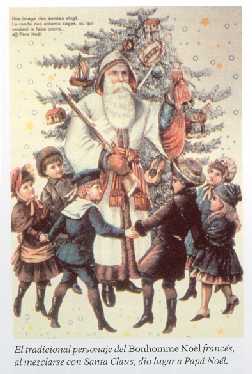
In the middle of the XIX century, the American figure of Santa Claus was exported to England, and later to France, where it was unified with Bonhomme Noel, a bearded character who dressed in white with bright decorations. From this union comes the current figure of Santa Claus, whose definitive appearance was designed in 1931 by Coca-Cola.
The habit of giving gifts to children in Christmas appears in the Ancient Era. Rome dedicated a festivity in December to Saturn (Chronos for the Greeks), in the end of which gifts were received by children. European children received them in later times, coming from very different characters, both religious (Wise Men in Spain) or pagans (the witch Befana in Italy).
Later on, Saint Nicholas replaced most of these characters. Since 1822, the Santa Claus visit is represented on Christmas Eve. Its adoption was very successful in the US because it satisfied a needs of the American society, as gifts were equally given to protestant, jewish, orthodox or lay children. Currently it is a pagan symbol accepted all around the world.

Thursday, December 21, 2006

Pirates (2/2)

It is in the territories far away from the "civilized" Occident that piracy gets to its greatest extempt. From the colonial era, with the introduction of quick, manoeuverable vessels built by States, the pirates cross the seas of West Indies and Orient, so large and far from the metropole that they become impossible to be controlled by the Europeans.

Skulls, filibusters and rhum

All started with the great demographic expansion in Europe at the 15th Century. Poor peasants and fishermen massively join up pirate vessels, which watch the trade routes followed by Spanish boats in the Atlantic and steal their gold booty.
From 1566, with the war between Spain and the United Provinces, England supports the latter by hiring privateers and equipping them with high quality vessels, able to fight openly to Spanish frigates.
During the 17th centur, however, the English government progressively retires its support. Privateers not enjoying its favour anymore became pure pirates again and even formed a confederation against the Navy. They progressively moved their activity to Iceland, Africa, Canada, and finally cocentrated in the West Indies.
The first pirates of the Caribbean (called filibusters, from Dutch vrijbuiter) established acting as traders of slaves, so did for instance the famous Hawkins and Drake (in fact, they usually "acquired" their slaves from Spanish and then legally sold them). In the 17th century, the Caribbean islands, emptied of indigenes thanks to the exterminating labour of the Spanish, were perfect hide-outs for them. The island of Tortuga is especially famous, it received several bands of pirates between 1630 and 1670.
Generally, piracy activities were done against Spanish vessels, as their cargoes were more promising, and this way, a little privateering was done against the common enemy. A very famous story tells that Cornelis Jol, "Pie de palo", and his band, entered Santiago de Cuba in 1635 dressed up as franciscan monks, and pillaged the city. In order to protect his galleons, Phillip II of Spain created light squadrons called "armadillas", which resulted very effective.
In parallel, another kind of dealers appear, the buccaneers, who are not pirates themselves. These Europeans settled in several islands, in groups of 15 to 20 men, where they learned from the natives the technique of meat conservation by smoking (or bucán). They established supplying posts, not officials but well known by merchants and pirates, and were generally respected by both.
Although filibusters were rougher pirates than the Mediterranean ones, they were certainly not sadic, as they are so often shown. In fact, they avoided violence unless it were necessary, except rare cases. They rather made psychological war, frightening and threatening their victims. One of their techniques was the use of the mythical skull and bones flag, the "Jolly Roger", although it was not started to be used until the end of 17th century. Before, national flags or monochromatic ones (red or black) were used.
From 1650, Nederlands, France and England use pirates, prisoners and soldiers to colonize several islands (Curaçao, Jamaica, Martinique). This way, some of the greatest pirates in History arise among them, such as Morgan, De Graaf, Nau "l'Olonnais" and Teach "Blackbeard". However, the States did not support them anymore, and a general repression was carried out. These last pirates ended up changing their activity (Morgan became governor of Jamaica and De Graaf made some business in Missouri), or dying tragically. In the middle of the 18th century, piracy had practically ceased to exist.

Pirates in Orient

In the Far East piracy was also a popular activity. Since the first trading exchanges, the cities of Canton and Macau were the richest in the area thanks to their situation in the middle of the routes. It was also the reason why the main attacks and pirate nests were concentrated in that zone, the most important being the Chinese Tanka, but also foreigners such as Philippines, Vietnamese and Japanese (called Wokou).
At the beginning of the 19th century a Pirate Confederation was formed, mainly by Chinese autochtone pirates, whose activity was focused to the attack to European ships. It was a well-organised confederation, which, even if granted action autonomy to every pirate, had a reglamentation on conflict solving, tactics, behaviour and booty share. It even had a Public Fund to which all the pirates contributed with a part of its booties.
However, after the Opium War, English, American and French carried out a campaign that eventually crushed the confederation, as the inferiority of the latter was huge against steam ships. From this moment, Western powers took over the trade and smuggling of spices, opium and slaves.

Sunday, December 10, 2006

Pirates (1/2)

Piracy exists since the first mariners sailed the seas, as it was a way to look for economic benefits for the people living at the coasts, generally poor. At the beginning it was not a condemned activity, if it was not done to fellow citizens. It was actually licit, and even praised, when the victim was a foreign. Homer wrote in his works about the adventures of Achilles and Menelaus, who did not hesitate to do lucrative pillages in enemy territoty, and Ulysses, who established his hide-out in the island of Itaca.

The Ancient Mediterranean

After the disappearing of the Minoian civilization, there is not a clear ruler of the Mediterranean anymore. Since the city-states start to arise, this sea becomes a busy trade route, and unsafe at the same time. Etrurian and Thracian pirates attack periodically the Greek and southern Italian coasts. Phoenicians associate the concepts of piracy and trade, and feed their slave trade this way. The island of Crete becomes the greatest pirate nest in the Mediterranean. It was not until the VI century BC that Athens carried out the first campaign against the pirates in order to have peace for its trade routes. At that time, the fact of being a pirate starts to be disapproved, as this activity looks for an individual benefit instead that for the community.
Rome had serious problems with Cilician pirates, who assaulted Sicily and reached as far as Ostia. It even seems that Julius Caesar himself was kidnapped by the pirates when he was young (although immediately afterwards he looked for help, reached them and made them crucify). In the I century BC, Pompeius conquers Cilicy, and offers the pirates a smart choice: to join the Roman navy, or to be enslaved. During centuries, the "Mare Nostrum" was a safe place for Romand transport and trade, not being so though in the Atlantic coasts.
Medieval piracy

After Rome, Byzantium became the greatest Mediterranean power, but as it did not control the whole of the coasts, it had to face continuous attacks from Narentine, Cilician and North African pirates. In 1204 Constantinople is taken by the crusaders, who start making piracy activities in the Eastern coastlines and establish a lucrative trade of Arab and Turkish slaves. Genovese and Venetian trade routes were also watched and assaulted by Catalonians, Sicilians and Maltese. At this time appears the expression "far il corso", literally make his own way, used by mariners that join pirate vessels to leave their poverty situation. From there came the latin word "corsario", for "privateer".
In the North Sea, the seasons of Spring and Autumn, with its dense fogs, were an ideal place for piracy. First Vikings in the coastlines, and then Bretons, Irish and Bordolese in the trade routes of English, Dutch and Baltic ships. In the XIV century the Hansa appears, as a trade association between septentrional cities, with the aim of offering mutual protection. However the agreements were rarely accomplished, and while every lord had pirates at his service for acting against other cities.

Golden Age and decadence

From the XVI century, the piracy becomes a politic matter. Great States start to influence in it, by financing pirate vessels or signing anti-piracy agreements with other States. As a consequence of this influence, the new privateers have more modern and sofisticated ships, giving place to a true Golden Age of piracy. Most important were port cities of Argelia (Bejaia, Oran, Algiers), that were protected and financed by Muslim kingdoms, specially the Ottoman and the nasri of Granada, by using these privateers to weaken the influence of Christian kingdoms. It is the time of the Barbarossa brothers (Baba Aruj and Khaid ar Din) who, associeted to the Ottoman Empire, caused great losses to the Spanish fleet.
From the XVII century, the troubles caused by privateers to their own protectors make these retire progressively their support. At the XVIII century the fleets of England, France and the United Provinces were powerful enough to control the decadent pirate activity, that disappeared one century later.

Wednesday, December 06, 2006

A noble eagle or a scavenger ugly bird?

After the American Independence War, the Continental Congress of the recently created United States decided it was imperative to create a set of symbols to represent the new nation. Among them, a committee was designated to ellaborate the design of the future American Great Seal, since used for representation of the coat of arms and the president, as well as other institutions. This committee was composed by three men: John Adams, Thomas Jefferson and Benjamin Franklin.
One of the hottest arguments between the two latter was about choosing a bird to be included in the symbol, so that it represented the spirit and the moral of the new nation. Jefferson proposed the bald eagle as such, an endemic bird in North America, with an arrogant, vigilant look. A bird with this appearance, he thought, cannot be but a noble and brave one.

A bird with not much of a noble behaviour

However, if we observe the citations made by biologists and naturalists about the behaviour of this bird, such as the works of Mark Catesby and Meriwether Lewis, we can realie that this bird is actually all except noble and brave.
The bald eagle is a carnivore, not a good hunter though. It nearly always feeds of carrion from dead animals or rests abandoned by an imperial eagle. When it eats fish, it usually gets close to the tracks of migration for salmons, and catches those dead on their way. Or it just waits patiently that an osprey, very skilful in catching fishes on the fly but smaller than the bald eagle, fetches a fish, and then steal its food. However, it never dares to fight an imperial eagle, while they are the same size.

Analogies

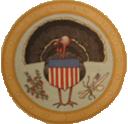
Benjamin Franklin never supported the bald eagle for the United States symbol. He said about it, in a letter to his daughter, that "it is a bird of bad moral character. He does not get his Living honestly. You may have seen him perched on some dead Tree near the River, where, too lazy to fish for himself, he watches the Labour of the Fishing Hawk; and when that diligent Bird has at length taken a Fish, and is bearing it to his Nest for the Support of his Mate and young Ones, the Bald Eagle pursues him and takes it from him." Franklin proposed the turkey as the symbol, a truly brave and arrogant bird according to him.
The 20th June 1784, the Congress supported Jefferson and approved the bald eagle as part of the Seal. Did Jefferson suspect what would the American relations be like towards politically weaker countries, and in the contrary, in situations in which it would compete with someone with its same size? The extermination wars against American natives, economic fagocitation of South America, predation with oil resources, sale of weapons to countries in civil war... and at the same time, negation of inconditional help to Europe during the Nazi invasion, the political game played with the Soviet Union (another bald eagle, but a bit more foolish), or the likely little heroic retreat from Irak... Actually, the bald eagle is perfect for this symbol. What a black humour, Jefferson.