Showing posts with label Age: Modern. Show all posts

Wednesday, May 21, 2008

Pennsylvania, land of sects

Have you ever seen "Witness"? Amish and Mennonites are Christian communities that reject certain aspects of modern society and, by own decision, do not follow its pace of life nor many of the habits related to technology and progressis ideas. But where did they come from, and how their particular way of understanding religion arose? And, why did they settle such deep roots in Pennsylvania (USA)?

Religious unrest in Europe

It all started in the Swiss city of Zurich, in January 1525. They were the years of the religious reformation started by Luther. In every European city, new Christian theologies, interpretations and trends arose that questioned the Roman doctrine. The priest Ulrich Zwingli, leader of the reformist movement in Zurich, had a quarrel with a group, led by Conrad Grebel, that wanted a faster, more radical reform. They called theirselves "anabptists" (re-baptizers), as they opposed children baptism for considering that unvolunteer, and claimed all baptism to be made during the adult life. However, they also defended the total separation between Church and State, and this led them to problems. The Zurich Council supported Zwingli and banished them from the city.

Faced with the bad welcome from the governors towards the new community, in 1527 the "Martyrs Synod" was held in Augsburg, where the main followers of the movement settled the theological bases for the Anabaptism. Little after its celebration, most of its participants were arrested and executed.

From this moment, Anabaptists (called thereafter Mennonites, on behalf of Menno Simons, one of its Dutch spiritual leaders) were persecuted as much by Catholics as by Lutherans, and murdered by thousands. This forced them to gather in secrecy at night, in caves or in their homes. Little by little, they closed their minds towards society, and changed their intention for evangelization to living in a humble way, "evangelizing with the example". One of its groups joined, during the 17th Century, the official Swiss State Church, and achieved a ceasement of prosecutions. Because of this, the rest of the Mennonites split. In 1693, the young Jacob Amman broke up with his community, accusing it of being tolerant with the Mennonites integrated in the Church. He eventually formed, together with some followers, the Amish community, representing since then the radical trend of Mennonite ideology.

America: freedom and fiscal exemptions? Let's go then!

During the 17th Century, the existence of Amish and Mennonites in Europe was more or less accepted, but never ceased to disturb the princes, and in fact, in some territories prosecutions lasted until 1710. These comunities roamed from country to country, subject to the tolerance of Gonvernments and the usefulness they could see in them. In effect, Mennonites were famous by their tenacity in work, their pacifism and lack of interest in politics. Thus, if they could be conveniently isolated from society, they would become useful to recover empoverished soil and plow wild lands. Governors just had to invent laws to force them not be seen from the public: they were forced to build their churches in the back streets, and were forbidden to toll the bells before the masses. Higher taxes than the rest of the population finished to cut off their influence power.

In the middle of the 17th Century, most Mennonites fled the Netherlands, were they had enjoyed a relative calm for years. Harder living conditions led them to move to Germany, in the regions of Westphalia, Saxony and Hamburg, where they joined a group of existing Quakers, also confined to those lands. Quakers were had recently appeared in puritan England, as a movement that defended a free, personal meditation about religion, and were appropiatedly persecuted by the Anglican Church.

It was among this group of discriminated Quakers and Mennonites that land owner William Penn (also a Quaker) asked for settlers for his new colony. Penn had received in 1681, thanks to his influential family, the lands of the region named Sylvania by him (later switched to Pennsylvania on his name), and he there created a territory with its own laws that guaranteed freedom of cult and an equitative tax fee. The first American colony of this kind was a Mennonite family and twelve Quaker ones, who founded Germantown, outside Philadelphia, in 1683. During the next years, 2500 Mennonites and 500 Amish reached the region, slowly moving to the western Lancaster County, of wilder and cheaper lands. A variant of Dutch and German was, and is still today in some groups, their official language.

Among these communities, new splits soon happened, contrary to their European analogues, who eventually merged into a single Mennonite Church. In America, the Old Order Mennonite eventually differentiated from other communities. Those became the typical, simple farms inhabited by long-bearded characters, reluctant to the use of technology, even using buttons, and the high education of their children. Their values have always been the feeling of belonging to a community, love for the land, and a religious education oriented to craft jobs.

Amish have been, since their appearing, exempt from military service and out of the social security system, as they believe themselves as the only ones with the right to take care of the community. This also happens in other services, almost every church has a life insurance for the community members. Mennonite Disaster Service is an American network of volunteers who act in national or local emergencies. The example of Amish Lancaster County is curious, as they created their own firemen brigade in 1885.

Dissident Mennonites

The rest of Mennonite groups (Hutterites, Mennonites of the Church of God in Christ, Brethren in Christ) , some more puritan and others more progressist, share most of their doctrine with th first, but varying some behaviours or interpretations from some Bible versicles. Probably, the oddest of these is the one that founded the Ephrata Cloister, in Lancaster County (Pennsylvania) in 1732. These descended from a pietistic branch of German Mennonites settled in Germantown, from which in 1728, the Seventh Day Dunkers had split. They only differentiated from the first in their use of Saturday as sacred rest day.

Among them, charismatic Conrad Beissel founded the hermit community of which he self-proclaimed the leader. This community tried to live as similarly as possible to the imagined life in Heaven. Living in the monastery was subject to a very harsh discipline, involving a six hour sleep per day in a wooden box, and eat a single vegetarian meal per day (although the Bible never mentions that in Heaven one must eat, it was thought that without that, the community would not last long). Life expectancy in the cloister was always quite low. Beissel was convinced that Christ would come back to the World while he would still be alive, and He would do it "as a robber in the night". So, every night, the whole monastery had to wake up from 0 AM to 2 AM to watch fir His arrival. At the leader's death in 1768, the community lost its meaning and most of its members were integrated into the Baptist Seventh Day Church, which actually was the closest to their doctrine.

Thursday, November 01, 2007

A retirement that resulted expensive

The reign of Philip IV of Spain, "the Planet King", witnessed one of the biggest urbanistic disasters in Modern History. It was the Palace of Buen Retiro ("Good Retirement"), that his minister the Count-Duke of Olivares planned in 1629 so that the decadent Court was entertained and therefore put aside of government responsibilities.

El Buen Retiro

The place started up being a terrain property of the Count-Duke close to the Monastery of Jerónimos in Madrid, later acquiring nearby lands from the marquises of Poyar and Tavera, besides donations of the city itself, becoming a terrain of 145 hectares.

The project was encharged to the architects Giovanni Battista Crescenzi and Alonso Carbonell, who designed large gardens with woodlands and entertainment areas, ponds, theatres, one colosseum, one lion's den and an exihbition of exotic birds. Since 1633 the greatest king partyies were celebrated in here, if they were dances, bullfightings, naumachias, and performance of the best playwrights of the Golden Century (Calderón de la Barca, Lope de Vega and Tirso de Molina acted there). During his reign, it was never open to the population.

But outside the reality was very different. The people of Madrid, overwhelmed with oppressive taxes to pay the endless Flanders wars and with an inflation caused by the gold from America, was in a precary situation. And the works carried out in El Retiro only caused a greater poverty, riots and critics.

Worsening the problem

The king's obsession for collecting artworks took him to buy large collections of pictures (more tan 800 in ten years) from painters in Madrid, Rome and Naples. In 1633, he asked for a palace-museum with luxury interiors able to store all these acquisitions. So it was imperative to plan a new great building, to which the king continously added endless annexes, and make it in a cheap and quick manner in order to silence critics. The palace was built in only seven years, leading the country to near economic collapse, and using low-quality materials (stone only in basements, the walls were made of bricks and forge was wooden).

Quevedo is attributed the verses "it is not a good occasion / that when so many disasters happen / you make water fountains spring / you are making retirements (Retiros) / and not loneliness". Matías de Novoa blamed Olivares for "making a ridiculous, non-profitable building and useless in all manners, of thin walls and weak basements, unfavoured by Nature and Heaven, sterile and sandy, wanting to force it to fecundity and decoration from plants helped by money, not from him or his possessions, but from the belongings of the city". The capital was full of rumours and jokes about the palace, that was called "the hen run", due to its exterior ugliness and the big bird store it housed.

From 1735 to 1764, when the new Royal Palace was built, the royal family had to live in the Palace of El Retiro, that hated it because of the walls' slimness and the low quality of the building. This was finally the cause of its end, a progressive degradation that, when the French installed there during the Independence War, provoked the complete ruin of the palace.

The palace was a good reflection of Philip IVth reign, a greatness built on mud feet. Its sad end came with its pulling down by order of Isabella II, and the requalification and sale of its lands, that had already become the centre of Madrid, in what became one of the great fishy urbanistic deals in Spain History. Today the majority of the gardens (completely reformed) remains, and also a salon for parties (Casón del Buen Retiro).

Thursday, October 11, 2007

Amazing Benin

In 1602 the Dutch merchant Pieter de Marees described the city of Edo (now Benin City), capital of the Benin Empire, this way: "The walled city of Benin is composed by a system of huge straight streets. These streets, although not paved, are very wide and well maintained [...]. Fine and big wooden houses are based along the streets, provided with covered porchs [...]. The king's court is very big, with galleries as large as the largest in Amsterdam, constantly watched, and supported by wooden pillars encased with copper on which engravings with past battles were depicted. I went so deep inside this building that, wherever I looked around, I could see gate after gate that finished in other places" [de Marees, 1602].

In his work "Description of Guinea", where he compiled information about uses and habitudes of indigenous people of the Benin Coast, de Marees mainly described the people as "bellicose, promiscuous, savage and thiefs". However, he managed to capture many aspects of the advanced Bini culture.

Amazing Benin

In effect, Europeans there found an Empire with a complex administrative system. The king, the Oba, exercised a great religious power (in fact the country never converted to Christianism) and also political, although the latter was supervised by two councils, an hereditary one (the Uzama) and an elected one, composed by territory chiefs, and lot of influence over the Oba's decisions. Most of the kings in the nearby territories also had a non hereditary title elected by the people.

The Benin Empire culture was, contrary to the one of European colonizers, very social. As long as in Europe the land was seen as a property and an investment, in Africa it was a common property, in which each individual possessed the right to work parts of it, but never over the land itself, as it belonged to the clan or the community. The same way, the name of new born children was decided as common agreement of the people.


A tricky Golden Age

The arrival of the Portuguese meant a deep social change. The Bini did not have the habitude of making trade exchanges aiming luxury, but the behaviour of land possession eagerness, characteristic of Europeans, was finally imitated by the indigenous. "As time passed by, they earned so much knowledge about their products that they almost surpassed us" [de Marees, 1602]. In effect, after a time of trade agreements, Africans understood that Europeans did not have the gold from Benin neither the copper from Sahara, so they had the power of rising prices as there were more and more clients and it was an increasingly valuable business, to the extent that "they became so proud and anxious as greedy rich men. After realising it was good merchandise, they tried by all means to falsify gold itself, transforming 100 grams in 150 and this way cheating foreigners".

Benin people had a deep alcohol culture, as they constantly used it in celebrations of births, offerings, worship to the land and lots of social rites. They distilled it from honey, plants and millet, and produced a kind of low graduation rum, so that when they tried the strong liquor Europeans brought, alcoholism became a common illnes. De Marees said that "they were naturally great drinkers" and, because of the lack of habit to this drink, became easily aggressive. This circumstance was very used by Europeans, together with traffic of firearms, in order to promote tribal wars that became a source to start slave trade.

This way, the Benin Empire complemented gold trade with ivory, pepper, furs, and specially slaves obtained in wars. Along the 16th and 17th centuries, it became the richest and most powerful Empire in West Africa, and a trade class appeared with a desire for luxury comparable to the Western one. British explorers realised the Oba was able to rise an army of twenty thousand men in one single day, and up to one hundred thousand men if necessary.
The end of the Empire came with the abolishment of slavery, of which its wealth had become totally dependent, and Benin entered a period of decadence that meant a lowering of richness, territorial losses and migration. This way, in 1897, the British occupied and pillaged the city of Edo. The kingdom became the protectorate of Nigeria, and the magnificent Bini artworks are now kept in a room in the British Museum.

Sunday, April 22, 2007

Why did Descartes die?

René Descartes, the man considered as precursor of Scientific Method and author of revolutionary books such as his Discourse on Method, died in obscure circunstances that were not cleared out until recently.

In 1646, the impulsive Queen Kristina of Sweden, ethusiast of Arts and Philosophy (although not with deep thoughts, as Descartes himself admitted), started to write letters with the philosopher, who was at that time retired in Nederlands. Impressed by his teachings, she invited him to the Swedish Court as a guest to give her lessons on Mathematics and Philosophy. This was part of her plan to be surrounded by great European thinkers and transform Stockholm into a cultural centre.

After some forceful "invitations", for which the queen sent one of her admirals, and later even a warship, in 1649 Descartes reluctantly accepted her proposal. In Stockholm he was received with high honours, incorporated to the Swedish aristocracy, and granted conquered lands in Germany.

Death at the Court

He did not enjoy life in the court, however. Apart from some punctual jobs (such as some lines in French for a ballet, or plans for the Swedish Academy) he only had to teach the queen during the mornings. The problem is that Kristina got up extremely early, and scheduled their lessons at 5 in the morning in the middle of Swedish winter. This was very hard for Descartes, who was used to stay in bed reading and thinking until noon. He usually said, "men's thoughts freeze here in winter, same as water". Five months after his arrival, the 11th February 1650, he died.

The official version of the time was that he died of pneumonia. After treating the French ambassador in Stockholm, who had contracted this contagious illness, Descartes got also ill and died one week later. Considering he was not used to nordic cold, this seems plausible. He was buried in a cemetery for unbaptised kids (because he was a catholic in a protestant country), and some years later his remains were moved back to France. Closed case.

However, the French ambassador, Hector P. Chanut, graved this quote in his headstone: "he expiated his rivals' attacks with the innocency of his life". So, he could have been murdered. There was enough reasons actually, as he was a catholic with more influence than most nobles. He could have been considered dangerous and cause of the Queen's catholicist trends (who, four years later, abdicated, converted, and moved to Rome).

Proof of the lie

In 1980, by complete chance, the prove was found. The German scientific Eike Pies, reviewing letters from his ancestor Willem Piso at Leyden University (Nederlands), saw a letter sent to him by Johann van Wullen, personal doctor of Queen Kristina and witness of Descartes' agony. In that letter, the details on the symptoms are described day by day: weakening, vomits, diarrhoea, dizziness, skin's pigmentation, cutaneous damages, entheritis... symptoms commonly found in an Arsenic intoxication.

So, Descartes was almost certainly poisoned. How was the truth hidden? In the letter, Wullen points out that the Queen asked to read it before being sent, and ordered that it never fell in strange hands. Kristina probably wanted to save the prestige of Swedish monarchy, already target of rumours and palace intrigues because of the Queen's excentricities. This way, the murder was never investigated. And History books still tell the "official" version of the facts.

Sunday, February 25, 2007

Human sacrifices to Huitzilopochtli


In summer 1521, the small army of the conquistador Hernán Cortés had been expelled from Tenochtitlan by the Aztecs, 62 of his soldiers taken prisoners during the fight. From outside the lake of the mexica capital, Cortés saw, powerless, the Aztec priests dispose these prisoners on the pyramid-temple altars, opened their chests and offered their beating hearts to the god Huitzilopochtli.

The chronicle of the swordsman Bernal Díaz tells these facts. Ritual sacrifice was perceived by Cortés as a threat and intimidation from the Aztecs. It probably arised a feeling of rejection and revenge in him, that influenced the later extermination of Aztec culture. However, the ritual sacrifice had a very different meaning.

In Aztec culture, human sacrifices were common during celebrations or natural disasters. Spilling human blood was a means to be humilliated in order to express gratitude and pay the debt towards the gods, for the sacrifice they did themselves in the creation of the world. Auto-sacrifice was the most widespread way, being common the fact of perforating sometimes several parts of the body with obsidian (especially ear, tongue and penis).

When the sacrifice involved offering the life of another person, this was rarely a slave (as the sacrifice became less valuable). It was usually a free person voluntarily offered or a war prisoner. The latter type of sacrifice, in which a jaguar warrior offered his prisoner to Huitzilopotchli, god of Sun and War, was the most widespread among Aztecs. The rite usually consisted in a ritual dance performed by both victim and warrior, and later the priest took the heart out from the victim's chest on the sacrifice altar. Right afterwards, the victim's body was offered to the warrior's family. They then ate his flesh and carried his skin for several days. What explanation has such an extravagant rite?

A complex meaning

In Meso-American cultures, the concept of the individual is relative. The nature of the "me" does not exist as itself, but as other individuals see it. This way, a jaguar sees other jaguars the same way a human sees other humans. The sacrifice rite is, in this context, a ceremony of assimilation, of an attempt to become the other. By eating his flesh, and carrying his skin, the warrior and his family personify their enemy, who defines who are themselves. In this manner, the sacrifier becomes, momentaneously, a singular individual, not relative but absolute.

For the better quality of the rite, the victim must be as similar as possible as the sacrifier, that is, from a near origin. That is why, the sacrified that came from the nearby city of Tlaxcala were more ppreciated than those come from further. Spanish were, thus, a second-class type of victim.

An interesting aspect in the ritual sacrifice, is that the sacrifier assumes also the role of the victim (result of the assimilation of the other). When the family ate the victim's flesh, they were in mourning, and it was frequent to cry during the ceremony, same as if it were their relative who was dead.

So, although difficult to understand by the Western invaders, the true reason of the sacrifice was much more complex than they thought.

Sunday, February 11, 2007

History of the fork

The fork, unlike knife and spoon, has not always been part of table settings. In fact, its history is relatively very recent. Although it appeared in Greece as early as the 4th century, it did not start to be generally used until the Modern Ages. Before the fork was introduced, people would largely eat food with their hands, calling for a common spoon when required. For aristocrats, though, table manners appointed that only three fingers should be used to touch the food, leaving the little and ring fingers unused.

First attempts in Italy

From the 7th through the 13th Centuries, forks were fairly common among the wealthy in the Middle East and Byzantium. In the year 1005, the byzantine aristocrat Maria Argyropoulina married the future Doge of Venice, Domenico Selvo. During their wedding celebrations she dared to refuse to eat with her hands. Instead, she had one of her eunuchs cut her food into little pieces she was able to eat with a golden fork she carried with her, fact that was considered decadent by everybody. The princess died shortly after of some disease, and this was perceived as divine punishment. The cardinal bishop of Ostia, St Peter Damian, spoke "of the Venetian Doge's wife, whose body, after her excessive delicacy, entirely rotted away." He preached extensively against this extravagant instrument, calling it both diabolic (probably due to its Devil's trident-like form) and useless, as spaghetti and macaroni were so hard to eat with it. It must be noted that forks at that time were flat and two-pointed, thus much more difficult to handle.

Hence, fork disappeared for 300 years from Italian table, until the 16th century, when it was rediscovered thanks to a renewed social interest in cleanliness. In 1533, another royal marriage, that of Catherine de Medicis with the king Henry II of France, spread the use of the fork. The Italian princess made it fashionable in the French court. She introduced the usage of each guest arriving at a dinner with their own fork and spoon enclosed in a box called a "cadena".
Use in Europe

England saw its first fork when a traveller called Thomas Coryate described its using as good manners, after one of his journeys to Italy in 1608. In the beginning, he was ridiculised and mocked, and fork seen as an affectation. "Furcifer" he was called, which means "pitchfork handler" in Latin. The clergy perceived its use as an ungodlt act, by saying that "God in his wisdom has provided man with natural forks - his fingers. Therefore it is an insult to Him to substitute artificial metallic forks for them." However, in 1633, Charles I of England declared that "it is decent to use a fork", a statement that heralded the beginning of civilised table manners. After some years, every member of the British royal family and the court possessed a fork. Its use was slowly spread among the wealthy in England, as imitating Italian habits was seen as sign of culture and refinement.

However, the way to use the fork remained a mystery revealed to only a few, well into the 18th century. Joseph Brasbridge, an English retail silversmith, wrote of his confusion in a customer's home, "I know how to sell these articles, but not how to use them." The king Louis XIV of France continued to eat with fingers or a knife for many years. Once he discovered its usefulness, though, he became the first host in Europe to provide complete sets of dinnerware for his guests, suppressing the necessity of the "cadena". He also ordered shape changes in dinner knives, such as rounding its point, as their pricking task was not needed anymore. In the 19th century, mass production and the invention of the electroplating process made metallic forks affordable to a rising middle class who wished to emulate the nobility.

The fork shape has been subject to several changes. By the end of the 1600's, manufacturers were adding a third tine to denote the old custom of eating with just the first three fingers. In Italy, Gennaro Spadaccini was the first to add a fourth tine and round its sharp points, under the order of king Ferdinand to adapt it for the eating of spaghetti. Finally, in the beginning of the 18th century, the curved fork was developed in Germany, coming out in the tool we know today. The additional tines made diners less likely to drop food, and the curved tines served as a scoop so people did not have to constantly switch to a spoon while eating.

Saturday, February 03, 2007

Gustaf's military revolution

The first example of combined arms can be seen in the Swedish army during the 30 years war. The unprecedented interaction between infantry, musketeers, cavalry and artillery that king Gustaf Adolf of Sweden introduced, supposed the beginning of the modern warfare.

Until the 17th century, tactis were still much alike in the late middle ages. Blocks of infantry and cavalry acted separately, while artillery remained an inmobile, heavy unit for support or siege. The cavalry itself had lost the role of stormtroop it had before, as it relyed on heavily armored horsemen that performed shy movements of pistol attack and retreat, called "caracole". The infantry formation was the "tercio", a bulk group of pikemen surrounded by arquebusiers, where the long spears of the first provided protection to the latter. As early firearms were short-ranged and slow to charge, this conservative structure showed a good performance to the Spanish Empire at the time, in spite of confering warfare a complete lack of offensive. With the introduction of the field artillery, it became a very vulnerable target.

The Gustaf revolution

Gustaf had developed a new army, where mobility became the strongest feature. As a first measure, the arms and armors of the soldiers were significantly reduced, even to just light harnesses in the case of cavalry. Pikes were reduced to 3 metres (instead of 6), and muskets were made lighter, so that "fork" was not needed anymore.

The tercios of the Spanish tactical school were abolished. Gustaf's infantry instead used linear formations, much more mobile by the quick ordering from line to column. Musketeers could all fire at the same target and quickly alternate different lines of fire. Their tactics also changed: they usually shooted in salvos, instead of individually, provoking a psychological effect on the enemy. Right after the shot, a charge of pikemen (with their new maneuvrable pikes) crushed the weakened enemy. This combination gave back the infantry the offensive role it had lost.

The Swedish cavalry also favored the shocking effect of the charge. The caracolle was ineffective since the lethality of the pistol was low. Gustaf's horsemen instead advanced on the trot firing their pistols and then charged at full speed with drawn swords, especially vulenrable targest such as enemy cavalry in caracolle retreat or field artillery. The cavalry was also supported by units of musketeers granting it more deffensive capability.

The greatest improvement was that of the artillery, though. Gustaf and his artillery chief, Lennart Torstensson, decided to create a type of light artillery, of pieces of "only" 150 kg (while 1500 kg of the traditional cannons). This new artillery could perfectly follow infantry and even cavalry displacements, thus acting as a short-range, effective support at all time. These units of light artillery, moreover, were not assigned in an exclusive regiment. Instead, each infantry or cavalry regiment was provided with several pieces of artillery to the order of the same commander. This apparently simple issue proved to be essential, as this case of splitting had never been the case before.

The result? The German Catholic League was massacred at the battle of Breitenfeld, and the time of the Swedish Empire started. The old military tactics were suddenly abandoned and remplaced by Gustaf's ones. Napoleon itself considered Gustaf as one of his military inspirators.

Thursday, December 21, 2006

Pirates (2/2)

It is in the territories far away from the "civilized" Occident that piracy gets to its greatest extempt. From the colonial era, with the introduction of quick, manoeuverable vessels built by States, the pirates cross the seas of West Indies and Orient, so large and far from the metropole that they become impossible to be controlled by the Europeans.

Skulls, filibusters and rhum

All started with the great demographic expansion in Europe at the 15th Century. Poor peasants and fishermen massively join up pirate vessels, which watch the trade routes followed by Spanish boats in the Atlantic and steal their gold booty.
From 1566, with the war between Spain and the United Provinces, England supports the latter by hiring privateers and equipping them with high quality vessels, able to fight openly to Spanish frigates.
During the 17th centur, however, the English government progressively retires its support. Privateers not enjoying its favour anymore became pure pirates again and even formed a confederation against the Navy. They progressively moved their activity to Iceland, Africa, Canada, and finally cocentrated in the West Indies.
The first pirates of the Caribbean (called filibusters, from Dutch vrijbuiter) established acting as traders of slaves, so did for instance the famous Hawkins and Drake (in fact, they usually "acquired" their slaves from Spanish and then legally sold them). In the 17th century, the Caribbean islands, emptied of indigenes thanks to the exterminating labour of the Spanish, were perfect hide-outs for them. The island of Tortuga is especially famous, it received several bands of pirates between 1630 and 1670.
Generally, piracy activities were done against Spanish vessels, as their cargoes were more promising, and this way, a little privateering was done against the common enemy. A very famous story tells that Cornelis Jol, "Pie de palo", and his band, entered Santiago de Cuba in 1635 dressed up as franciscan monks, and pillaged the city. In order to protect his galleons, Phillip II of Spain created light squadrons called "armadillas", which resulted very effective.
In parallel, another kind of dealers appear, the buccaneers, who are not pirates themselves. These Europeans settled in several islands, in groups of 15 to 20 men, where they learned from the natives the technique of meat conservation by smoking (or bucán). They established supplying posts, not officials but well known by merchants and pirates, and were generally respected by both.
Although filibusters were rougher pirates than the Mediterranean ones, they were certainly not sadic, as they are so often shown. In fact, they avoided violence unless it were necessary, except rare cases. They rather made psychological war, frightening and threatening their victims. One of their techniques was the use of the mythical skull and bones flag, the "Jolly Roger", although it was not started to be used until the end of 17th century. Before, national flags or monochromatic ones (red or black) were used.
From 1650, Nederlands, France and England use pirates, prisoners and soldiers to colonize several islands (Curaçao, Jamaica, Martinique). This way, some of the greatest pirates in History arise among them, such as Morgan, De Graaf, Nau "l'Olonnais" and Teach "Blackbeard". However, the States did not support them anymore, and a general repression was carried out. These last pirates ended up changing their activity (Morgan became governor of Jamaica and De Graaf made some business in Missouri), or dying tragically. In the middle of the 18th century, piracy had practically ceased to exist.

Pirates in Orient

In the Far East piracy was also a popular activity. Since the first trading exchanges, the cities of Canton and Macau were the richest in the area thanks to their situation in the middle of the routes. It was also the reason why the main attacks and pirate nests were concentrated in that zone, the most important being the Chinese Tanka, but also foreigners such as Philippines, Vietnamese and Japanese (called Wokou).
At the beginning of the 19th century a Pirate Confederation was formed, mainly by Chinese autochtone pirates, whose activity was focused to the attack to European ships. It was a well-organised confederation, which, even if granted action autonomy to every pirate, had a reglamentation on conflict solving, tactics, behaviour and booty share. It even had a Public Fund to which all the pirates contributed with a part of its booties.
However, after the Opium War, English, American and French carried out a campaign that eventually crushed the confederation, as the inferiority of the latter was huge against steam ships. From this moment, Western powers took over the trade and smuggling of spices, opium and slaves.

Wednesday, December 06, 2006

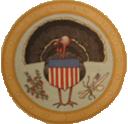
A noble eagle or a scavenger ugly bird?

After the American Independence War, the Continental Congress of the recently created United States decided it was imperative to create a set of symbols to represent the new nation. Among them, a committee was designated to ellaborate the design of the future American Great Seal, since used for representation of the coat of arms and the president, as well as other institutions. This committee was composed by three men: John Adams, Thomas Jefferson and Benjamin Franklin.
One of the hottest arguments between the two latter was about choosing a bird to be included in the symbol, so that it represented the spirit and the moral of the new nation. Jefferson proposed the bald eagle as such, an endemic bird in North America, with an arrogant, vigilant look. A bird with this appearance, he thought, cannot be but a noble and brave one.

A bird with not much of a noble behaviour

However, if we observe the citations made by biologists and naturalists about the behaviour of this bird, such as the works of Mark Catesby and Meriwether Lewis, we can realie that this bird is actually all except noble and brave.
The bald eagle is a carnivore, not a good hunter though. It nearly always feeds of carrion from dead animals or rests abandoned by an imperial eagle. When it eats fish, it usually gets close to the tracks of migration for salmons, and catches those dead on their way. Or it just waits patiently that an osprey, very skilful in catching fishes on the fly but smaller than the bald eagle, fetches a fish, and then steal its food. However, it never dares to fight an imperial eagle, while they are the same size.

Analogies

Benjamin Franklin never supported the bald eagle for the United States symbol. He said about it, in a letter to his daughter, that "it is a bird of bad moral character. He does not get his Living honestly. You may have seen him perched on some dead Tree near the River, where, too lazy to fish for himself, he watches the Labour of the Fishing Hawk; and when that diligent Bird has at length taken a Fish, and is bearing it to his Nest for the Support of his Mate and young Ones, the Bald Eagle pursues him and takes it from him." Franklin proposed the turkey as the symbol, a truly brave and arrogant bird according to him.
The 20th June 1784, the Congress supported Jefferson and approved the bald eagle as part of the Seal. Did Jefferson suspect what would the American relations be like towards politically weaker countries, and in the contrary, in situations in which it would compete with someone with its same size? The extermination wars against American natives, economic fagocitation of South America, predation with oil resources, sale of weapons to countries in civil war... and at the same time, negation of inconditional help to Europe during the Nazi invasion, the political game played with the Soviet Union (another bald eagle, but a bit more foolish), or the likely little heroic retreat from Irak... Actually, the bald eagle is perfect for this symbol. What a black humour, Jefferson.

Tuesday, October 24, 2006

The true Robespierre

Robespierre is one of the main characteres in the French Revolution, but also that sanguinary tyrant who sent thousands of people to guillotine during the Terror era. However, the ones who write History are usually the winners of the moment, which in this particular moment were the enemies that provoked his downfall. Let's try to be more critical.

A respectable citizen

Maximilien Robespierre was born in Arras, in the French Picardie. From a middle-class family, he could follow Law courses as his grandfather, where he stood out as a particularly brilliant student. While working as a lawyer, he wrote several law books that gave him a good reputation in the town. Being known as an inconditional supporter of Rousseau's revolutionary theories, he was one of the most respectable citizens of the region, being especially known for his correction, honesty and absolute sincerity.
In 1788 revolutionary ideas became more popular, and Robespierre started influencing political ambiances in the town, where he was chosen for several political jobs in Arras and later in Paris, where his position in defense of poor peasants granted him the support of the people while his brilliant speeches. He entered the Jacobins Club, the radical left-wing group, of which he eventually became the spiritual leader after the disappearing of its founding leaders (Barnave, Mirabeau). The attitude Robespierre took during the events that followed, and especially the speeches in which he exposed it, gave him an increasing popularity within the Revolutionary Government, which eventually lead him to be elected as a member of the Public Security Commitee. He had opposed the war with Austria, and had supported the execution of King Louis XVI, by pronouncing his popular sentence "Louis must die, so that the country can live". The failure that the contrary position Girondins took meant their destruction, and the consolidation of Robespierre as the leader of the National Convention, new era of the Revolution.
From 1792 to his downfall two years later, more than 30000 people were guilotined in Paris, denounced by the Convention as traitors to the Revolution. Robespierre and his little buddies increased progressively repressive actions, also among the members of the Government. Danton and Hébert, supporters of Robespierre but from different factions, were executed, and the Government was increasingly pointed out as a dictatorship. Finally, a raising of the people provoked the Convention overthrown and the execution of its tyrant, in July 1794.

A cruel tyrant?

It is uncontested that Robespierre created an authoritary and repressive state, almost a dictatorship in the middle of the Revolution. However, which were the reasons for his actions? Actually, a personal dictatorship does not match with the ideas he defended, and maybe he never really liked sending citizens to the guillotine (he dismissed from a judge job at Criminal Court of Arras to avoid pronouncing death sentences). It is imaginable that after the overthrown of the Convention, many members of the Commitee blamed Robespierre, already dead, for all the atrocities that happened, and so saved their lives.
Robespierre was a theorist and a philosopher. During his political career, he formulated laws, wrote essays and gave speeches. The ideas from his idol Rousseau, which defended the people's power especially over individual freedom, were the defining ideas of his Government, that he described as "the despotism of freedom against tyranny". As a theorist, he tried to apply his ideas in an inflexible way, to the point that he did not hesitate to eliminate his detractors. As a politician without pragmatic sense, he never betrayed his ideas, and was "incorruptible" until his death.